Craig DiLouie, LC, CLCP recently interviewed Gary Trott, VP of Intelligent Lighting and IoT Platform, Cree for an article for the October issue of tED Magazine, the official publication of the NAED. The topic: connected lighting’s potential role in the Internet of Things.
On July 26, 2018 the International Code Council published the 2018 version of the International Energy Conservation Code (IECC), which has been updated every three years since 2000. This 2018 version reduces lighting power allowances, broadens mandatory controls requirements, and issues clarifications.
Craig DiLouie, LC, CLCP recently interviewed Jamie Britnell, Director of Product Marketing – Lighting, Synapse Wireless for an article about the Internet of Things, which will be published in the October issue of tED Magazine.
With the right combination of dimmer and solid-state driver for LED products, dimming performance can achieve excellent results from 100% all the way to dark, smoothly and predictably, says Kevin Willmorth in his latest exclusive contribution. However, when the combination is wrong, many undesirable effects may occur, he points out. Investigating the reasons for these issues requires a basic understanding of where issues can arise.
Scott Ziegenfus, manager of government and industry relations at Hubbell Lighting, recently contributed an insightful article to LD+A Magazine about how lighting specifiers should approach a dialogue with client IT departments when specifying a networked lighting control system.
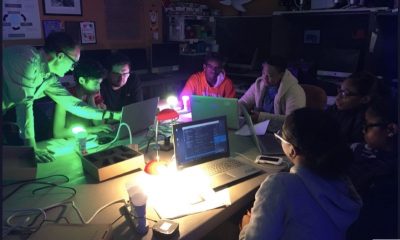
Stacks+Joules is a non-profit workforce training program designed to prepare high school seniors for jobs in the building automation field. This article by LCA Education Director Craig DiLouie describes the program and the role LCA’s Education Express plays in it.
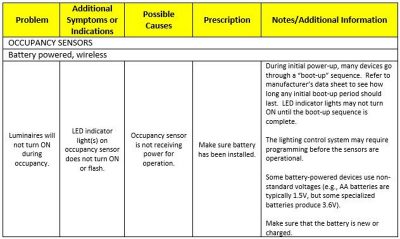
This guest post by Steve Mesh introduces the new Lighting Controls Association troubleshooting guide for networked lighting control systems.
Eaton’s The Lighting Resource recently published an article about dimming LED lamps and luminaires.
Hubbell’s Summer Albergotti and Marissa Keisler contributed an article to Facilities.net, “Human-Centric Lighting for Schools, Hospitals, and Offices.” The article describes how color tuning enables lighting systems to better serve the needs of users and spaces.
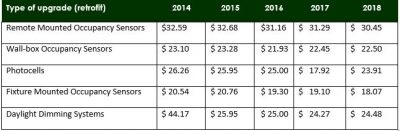
Table 2. Popular lighting control rebates. Source: BriteSwitch North American Rebate and Incentive Database, February 2018.
The most popular lighting control rebates continue to be occupancy sensors, light sensors, and daylight dimming systems. The average rebate for controls is fairly high when one considers their cost, positioning them as an attractive add-on to a retrofit. In some cases, such as high-bay lighting, the rebate can almost completely cover the cost of adding a luminaire-mounted occupancy sensor.
This article produced by Craig DiLouie, LC, CLCP for the May 2018 issue of tED Magazine presents a roundtable by lighting experts talking about the impact of connected lighting.
This article by Craig DiLouie, LC, CLCP, published in the March 2018 issue of ELECTRICAL CONTRACTOR, describes the latest developments in lighting control software.
California has been a historical leader in terms of state energy codes. California’s Title 24 has led the way by restricting allowable LPDs (Lighting Power Density) as well as mandating specific types of lighting controls. This article by Steve Mesh introduces the Title 24 energy code and its lighting control requirements.
The Lighting Controls Association is proud to offer an advance look at a selection of new products that will be displayed by members at LIGHTFAIR International May 6-10, 2018 in Chicago. While some can be seen here, many more await at member booths, so be sure to visit! SYNAPSE WIRELESS DIM10-087-06 The DIM10-087-06 adds the [...]
Craig DiLouie, LC, CLCP, recently had the pleasure of interviewing Jamie Britnell, Senior Product Manager, Synapse Wireless, Inc. about lighting control software for articles for ELECTRICAL CONTRACTOR and tED. Click to read the interview.
If you’re installing a lighting control system in 2018, you have to be concerned about cyber security. Why? Very simply – because many current lighting control systems are networked.
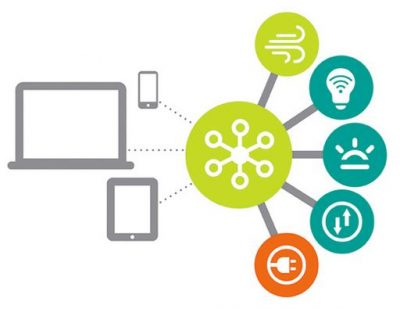
Image courtesy of Audacy Wireless Lighting Control
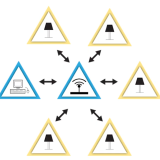
For input devices and luminaire controllers to interact in many applications, a signal pathway is needed. This may be wiring or, more recently, wireless, with control signals sent through the air. This approach eliminates the need for control wiring, resulting in significant benefits, particularly in existing buildings. Using wireless communication, control devices can communicate as discrete devices or as part of networked systems. Click to read this article by Steve Mesh, LC and Craig DiLouie, LC, CLCP.
Lutron’s Pekka Hakkarainen contributed an article to the February 2018 issue of ELECTROINDUSTRY, the NEMA magazine, in which he argues that specifiers should look beyond the lowest common denominator when it comes to lighting controls (energy code compliance) and instead look to realize their full value potential.
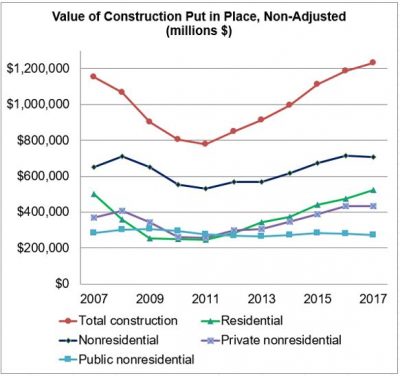
The U.S economy grew by 2.5% in 2017, outpacing 2016, and is expected to produce similar growth in 2018. A major contributor to the economy is construction, and the outlook for construction spending in 2018 overall is positive, particularly nonresidential. The AIA’s semi-annual Consensus Construction Forecast, a survey of the nation’s leading construction forecasters, is projecting 4% growth in nonresidential construction spending in 2018 and 3.9% in 2019.

Image courtesy of Lutron Electronics.
A new application for voice-control personal assistants is control of home systems such as lighting, shades, thermostats, A/V, security, and other smart devices. A typical solution includes a virtual assistant device (phone or speaker), Wi-Fi connection, downloadable smart device app, and a compatible lighting or home automation system. This article by Craig DiLouie, LC, CLCP describes typical solutions, how they work, and their benefits.
This guest article by Steve Mesh compares the pros and cons of room- versus building-based control systems.
While installing controls in new construction or full-scale remodeling is reasonably straightforward, retrofitting controls into an existing building or space can be somewhat problematic, especially when cutting into walls and ceilings is undesirable. To this end, the first step in assessing an appropriate approach is to establish what the goals of a retrofit are. Pure energy savings gains can be realized with simple ON-OFF controls additions, while inclusion of dimming functionality requires greater investment. Embracing more complex targets, such as inclusion of human factors driven lighting strategies are even more involved.
As the lighting market shifts to SSL technology, Current, powered by GE is one of many companies that are helping to reinforce U.S. manufacturing and R&D leadership. This will not only help bring significant energy savings through more-efficient lighting products, but will benefit our economy by adding jobs at multiple levels of the supply chain.
The Lighting Controls Association’s Education Director Craig DiLouie recently interviewed Terry Arbouw, Director of Business Development & Product Innovation at Hubbell Control Solutions, and Félix Omar Pérez, Product Manager – Energy Efficiency at Hubbell Wiring Systems. The topic: automatic plug load control.

Image courtesy of Eaton.
Controlling plug loads is a natural fit for the lighting controls industry, as the same devices and strategies are used for automatic shutoff of plug loads such as task lighting as for general lighting. This feature article by LCA Education Director Craig DiLouie, LC, CLCP looks at energy code requirements, compliance options, and control types.
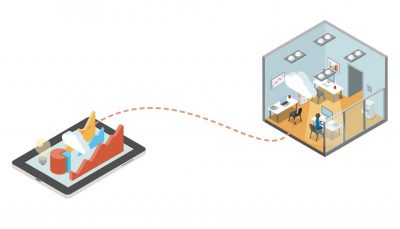
The general concept of the Internet of Things (IoT) is expansive and virtually without limit. The basis of the technology is that devices, appliances, building systems, computer networks, vehicles and personal smart devices become connected together in such a way as to exchange and process information or facilitate integrative control functionality. The impact this will have on industries and individuals is potentially profound.
In this LCA column, Kevin Willmorth looks at the Internet of Things and the role lighting is likely to play in it.
Power over Ethernet (PoE) lighting is part of a brave new world. The ascendance of LED fixtures has given rise to some new methods of providing and controlling light in our environments. Since LEDs are low-voltage devices that use direct current, they are a good match with a system that provides low-voltage DC power over Ethernet cables. Guess what? That’s a computer network! For several years, lighting (and computer) companies have been developing the idea of powering LED fixtures from what is essentially a computer network switch. As you might imagine, this gives rise to a host of questions about a variety of issues.
In this LCA column, Steve Mesh takes an in-depth look at power over Ethernet (PoE) systems.

Distribution of energy savings across the 114 buildings.
The DesignLights Consortium’s (DLC) new report, Energy Savings from Networked Lighting Control (NLC) Systems, estimates average lighting energy savings of 47% resulting from installation of networked lighting control systems. The report indicates high potential energy savings for networked controls, supports layered control strategies as a means to maximize savings, and may be used to justify new and larger utility rebates. Craig DiLouie, LC, CLCP breaks it down in this month’s featured article.
In this LCA column, Kevin Willmorth breaks down opportunities and challenges when controlling TLED lamps.
This Posting by Jim Brodrick, DOE’s SSL Program Manager, profiles Acuity Brands as an American manufacturer of LED products. Click to check it out.

Image courtesy of Eaton
Most commercial building energy codes require automatic lighting shutoff. This common-sense strategy also adds value to lighting upgrades in existing buildings. Remote switching is one method, with an option being switches residing in a metal cabinet-type enclosure called a panel. This panel can serve as the backbone for a complete energy code-compliant control system that responds to a wide range of control inputs for indoor and outdoor lighting control. It is typically sold as a new complete unit, though panelboard retrofit assemblies are available.
This article describes common panel-based lighting control systems.
Republication of Postings from the U.S. Department of Energy (DOE) Solid-State Lighting Program Headquartered in Greenville, SC, where more than 500 employees are based, Hubbell Lighting is a major manufacturer of LED and conventional luminaires and control solutions, and is one of the three largest lighting manufacturers based in the U.S. The company features a [...]
Republication of Postings from the U.S. Department of Energy (DOE) Solid-State Lighting Program by Jim Brodrick, SSL Program Manager, U.S. Department of Energy A new GATEWAY report on a trial installation of tunable-white LED lighting systems in three Texas classrooms provides valuable insights into the use of this technology in a real-world setting. While reducing [...]
LD+A recently published an article by the California Lighting Technology Center’s Cory Jackson, discussing why commercial lighting remains sparse in demand response programs and what can be done. She writes: After nearly two decades of support and research focused on automated demand response (ADR), lighting remains underutilized as a demand response resource. Beginning in 2007 [...]
In “Connectivity is The Key,” LD+A lighting control columnists Gary Meshberg, LC (chair, Lighting Controls Association) and Craig DiLouie, LC (education director) describe the revolution in lighting controls occurring in the area of connectivity and what this means for the future of lighting. The authors write: While basic connected lighting capabilities have been available for [...]
In May 2016, the DesignLights Consortium® (DLC) released V.1.0 of its Networked Lighting Control Systems Specification, which formed the basis of a new Qualified Lighting Products List (QPL). The intent was to provide utilities and energy efficiency programs a resource to qualify networked lighting control systems so they could be covered in commercial sector lighting [...]
Guest Post by Kevin Willmorth Flicker presents itself in several forms, each with its own cause. For lighting decision makers, avoiding flicker requires understanding what causes it and what can be done to avoid it. For a good understanding of what flicker is and how we see it, NEMA’s position paper TLAs-2015 Temporal Light Artifacts [...]
Guest post by Steve Mesh, LC A relatively recent trend in the industry is to embed “luminaire-integrated” (embedded) controls into each fixture. This can be done in different ways, with different types of components, and with different types of control systems. The most basic version of “luminaire-integrated” controls consists of on-board sensors that tell the [...]
Republication of Postings from the U.S. Department of Energy (DOE) Solid-State Lighting Program by Jim Brodrick, SSL Program Manager, U.S. Department of Energy It’s no secret that the explosion of connectivity triggered by the advent of the Internet of Things (IoT) is also impacting the lighting industry — to such an extent as to constitute [...]
The most recent Commercial Buildings Energy Consumption Survey (CBECS) collected new information about lighting control technologies and strategies in the United States in 2012. Compared with other investments in energy efficiency—such as upgrading heating, ventilation, and air-conditioning systems or replacing insulation—lighting controls are often “relatively easy, accessible, and affordable changes,” according to the Department of [...]