The Lighting Research Center (LRC) recently published a new DELTA report evaluating new sensor-controlled LED corridor lighting installed in a multifamily residential building in Albany, New York. The project showed significant energy savings while overall occupant response was positive.

Guest post by Steve Mesh, LC What is a “network”? One definition of “network” (from the Merriam-Webster app on my iPhone!) is … “an interconnected or interrelated chain, group, or system.” What kinds of components exist in an networked lighting control (NLC) system? That can vary from system to system. Are there basic elements that [...]

As the commercial lighting industry continues its steady move towards more advanced controls and lighting solutions, for many experts, all signs point to networked lighting controls. And when it comes to truly intelligent, flexible lighting with non-energy benefits, the future could be Luminaire Level Lighting Controls (LLLCs). A subset of networked lighting controls, LLLCs include integrated sensors and control in each fixture. To better understand this trend, Anne Curran, Senior Program Manager for the Northwest Energy Efficiency Alliance’s Luminaire Level Lighting Controls initiative, interviewed Shaun Darragh, Senior Lighting Specialist at Lighting Design Lab. Here’s the transcript.
As the commercial lighting industry continues its steady move towards more advanced controls and lighting solutions, for many experts, all signs point to networked lighting controls. And when it comes to truly intelligent, flexible lighting with non-energy benefits, the future could be Luminaire Level Lighting Controls (LLLCs). A subset of networked lighting controls, LLLCs include integrated sensors and control in each fixture. To better understand this trend, Anne Curran, Senior Program Manager for the Northwest Energy Efficiency Alliance’s Luminaire Level Lighting Controls initiative, interviewed Chris Meek, Associate Professor of Architecture at the University of Washington. Here’s the transcript.

This article provides general introductory knowledge about the lighting control requirements imposed by the 2016 version of ASHRAE/IES 90.1 and the 2018 version of the IECC.

Early in 2019, ELECTRICAL CONTRACTOR conducted a survey developed by Craig DiLouie, LC, CLCP to gauge familiarity with major lighting trends, including networked lighting controls and wireless controls. Here are some key findings.

In 2018, the California Lighting Technology Center (CLTC) published “Daylight Harvesting for Commercial Buildings Guide,” a best practices guide to designing daylight harvesting systems. While focused on compliance with California’s tough energy code, the information has broad application.

“Communication is key to ensuring compatibility between controllers and drivers,” write Elizabeth Johnson, Senior Associate, and C. Webster Marsh, Designer, of Horton Lees Brogden Lighting Design in an article about analog dimming.

Craig DiLouie, LC, CLCP recently had the opportunity to interview Michael Jouaneh, CEM, LEED AP, WELL Faculty, Manager—Sustainability and Energy Standards, Lutron Electronics Co., Inc. on the topic of how lighting and controls fit into the WELL Building Standard.

The Lighting Controls Association is proud to offer an advance look at a selection of dozens of new products that will be displayed by members at LIGHTFAIR International May 21-23, 2019 in Philadelphia.

“The reduction of overhead lighting to providing minimal background illumination, augmented by individualized lighting systems incorporating user control, delivers optimal use of facilities resources and energy, while creating a more agreeable, and arguably healthier work environment.”

Hand holding a microphone conducting a business interview or press conference
Craig DiLouie, LC, CLCP recently had the opportunity to interview David Buerer, Director of Product Management, Leviton, for an article for tED Magazine on the topic of nonresidential lighting control protocols.
Courtesy of Bluetooth, this infographic provides information about how connnected lighting systems are being used as a platform to enable advanced building services such as wayfinding, asset tracking, and space utilization to improve the ROI of smart building investments.

Hipster business successful teamwork concept, business group assembling jigsaw puzzle
Lighting as a Service (LaaS) is an emerging and evolving business model in which the owner pays for light rather than the equipment that delivers it. The owner buys new lighting on a subscription basis over a multi-year term rather than a significant one-time capital investment.
One of the most striking changes to the 2019 code version is the addition of Section 130.1(f)1-130.1(f)7 – “Control Interactions.”

Though much can be said about increasing communication with other building systems to offer a myriad of value to the digital building, lighting systems offer the building blocks to a smarter building now.
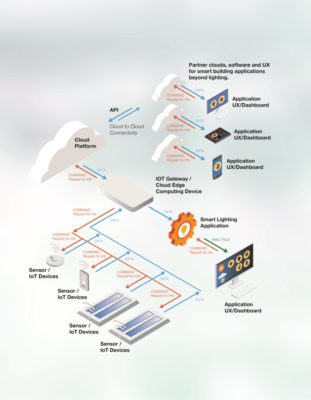
The Internet of Things at a glance, highlighting the lighting and networked control system. Data from sensors flows to a server or the Cloud, where it is analyzed and used for lighting management. Data can also be shared with other building systems and third-party software. The shown lighting and control system is readily achievable today. What happens beyond to create a single smart building that harvests and translates data into meaningful action is quickly developing. Image courtesy of OSRAM.
Networked lighting controls can reduce energy consumption by an average 47 percent, according to a recent industry study. That makes control a powerful tool in managing energy costs, but it only captures a small fraction of its potential value in enhancing quality lighting with LED technology.
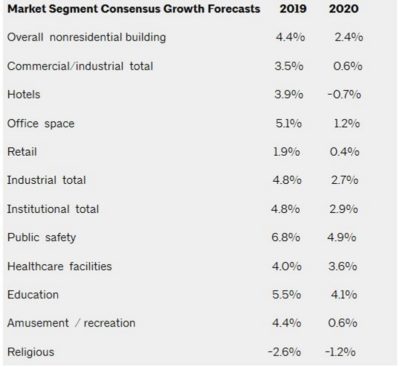
The AIA’s semi-annual Consensus Construction Forecast, a survey of the nation’s leading construction forecasters, is projecting 4.4% growth in nonresidential construction spending in 2019 and 2.4% in 2020. This article by Craig DiLouie, LC, CLCP reviews the forecast and leading construction industry economic indicators.

According to a recent research report by the market research and strategy consulting firm, Graphical Research, Europe Smart Lighting Market share will surpass USD $9 billion by 2024.
“Luminaire-Level Lighting Controls” (LLLCs) – this relatively new term in the lighting controls industry indicates that every fixture controlled by a networked lighting control system (NLC) incorporates two specific things: 1) a “controller”, and 2) sensors. This article by Steve Mesh describes the utility and application of this control approach, which is starting to be adopted by model energy codes.

McGuire Engineers’ John Yoon, PE, LEED AP ID+C recently contributed an article to CONSULTING-SPECIFYING ENGINEER citing 10 reasons why lighting controls commissioning may fail. It’s an excellent piece with plenty of helpful observations and guidance.

LUX Magazine recently published an article making a case that Bluetooth Mesh is positioned as a truly transformative protocol, enabling not only lighting control but capabilities far exceeding it.

Synapse recently published an online article providing guidance on how to implement daylight harvesting control strategies.
Steve Mesh writes, “According to Wikipedia, a communication protocol is a ‘system of rules that allow two or more entities of a communications system to transmit information via any kind of variation of a physical quantity.’ That’s a mouthful! What does that mean in terms of networked lighting control (NLC) systems?”
The Internet of Things (IoT) has become the talk of technologists everywhere, on every product level imaginable. Lighting is no exception. Understanding why this is such an energetic field requires thinking beyond conventional control and connectivity models. The integration of smart features opens the door to intelligent utilization of data and energy that cannot be achieved using closed, localized technologies that cannot be accessed beyond their limited utilitarian functionality.
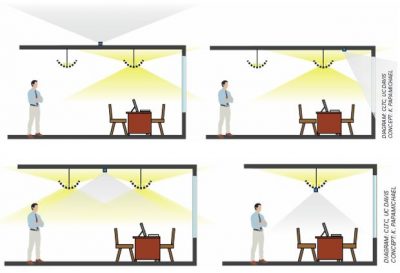
Photosensor placement and field of view for open-loop sensors (top) and closed-loop sensors (bottom). Image courtesy of CLTC.
In August 2018, the California Lighting Technology Center (CLTC) published a best practices guide for designing daylight harvesting lighting control systems. Titled Daylight Harvesting for Commercial Buildings Guide, it focuses on compliance with California’s Title 24 energy code, though it has broad application.

Craig DiLouie, LC, CLCP recently had the opportunity to interview Jonathan Cartrette, Systems Architect, Wattstopper/Legrand for an article that will be published in 2019 for ELECTRICAL CONTRACTOR. The topic? Lighting and cybersecurity.
In September, California passed SB-327, a cybersecurity law that will affect manufacturers of Internet of Things (IoT) and operational technology (OT) devices.

This article at Eaton’s THE SOURCE website provides an insightful look at how connected lighting can facilitate space optimization.

In August 2018, the DesignLights Consortium (DLC) released Energy Savings Potential of DLC Commercial Lighting and Networked Lighting Controls, which projects energy savings for LED commercial lighting and networked lighting controls. The report makes a case that to continue getting big energy savings from lighting for another decade, utility rebate program administrators should transition to supporting LED luminaires and networked controls.
In this guest post, LCA contributor Steve Mesh describes the “non-energy benefits” of connected lighting, which can add extraordinary value far beyond energy savings.

“As the lighting industry attempts to morph from its conventional role of illumination and become more of a provider of smart networks that collect data through chips and sensors embedded in the lighting infrastructure, it should focus its sales efforts on IT groups rather than on the customary facilities departments,” Mark Halper writes for LEDs Magazine.
“While the majority of installations today are distributed high voltage (between 110V and 347V), the emergence of solid-state lighting technology has brought into question whether this is the most practical and efficient way to feed future lighting systems … In general illumination application, there are currently two core approaches to operating luminaires directly from low voltage DC power. Emerge Alliance 24VDC distributed, and Power over Ethernet (PoE). The two approaches employ distinctly different control approaches.”

The Internet of Things at a glance, focusing on the lighting and control system. Data from sensors in a networked lighting system flows to a server or the Cloud, where it is analyzed at a workstation that in turn is used for lighting management. Data can also be shared with other building systems and third-party software. The shown lighting and control system is readily achievable today. What happens beyond to create a single smart building that harvests and translates data into meaningful action is developing. Image courtesy of Cree.
Networked control and connected luminaire manufacturers are now promoting their products as “IoT enabled.” This means when the IoT does arrive, the lighting system will stand ready to play a part in it without significant additional cost. The converse may also be regarded as true, which is without connected lighting, any new LED lighting may instantly become obsolete after installation.

In this guest post, Paul Rudalavage, Synergy Electrical Sales summarizes five key areas to understand and explore when purchasing a lighting control system.
“If you are a regular reader of Lighting Controls Association blog posts, then you know that networked lighting control systems (NLCs) are really computer networks – they just happen to control luminaires, occupancy sensors, photosensors and light switches. The paradigm shift for lighting control systems has occurred at lightning-fast speed in recent years … However, once you decide to piggyback onto an existing IT network, you are in the domain of the IT staff who works for the building’s owner.”

FACILITIES MAINTENANCE DECISIONS recently ran an article contributed by the Lighting Controls Association on how to apply lighting controls to existing buildings.

Image courtesy of Lutron Electronics.
Software plays a central role in commissioning, operating, and analyzing data collected by networked lighting control systems. As connected lighting becomes more popular, manufacturers continue to make their software simpler, more robust, more portable, and require less training. Software is a major touch point regarding the lighting control system serving either as a platform or an integral part of implementing the Internet of Things in commercial buildings.

“I recently wrote about how lighting energy allowances under current codes are now approaching a practical minimum, thanks to significant improvements in source efficacy, optical efficiency, and controls that automatically extinguish lighting when it is not needed.”
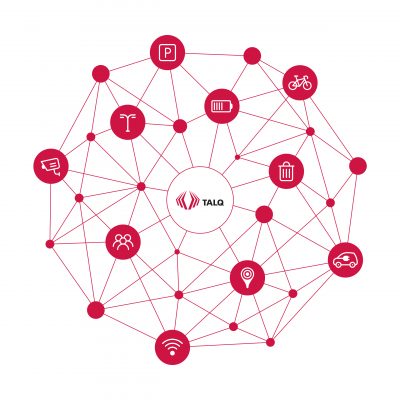
The TALQ Consortium reveals in a White Paper recently published a whitepaper detailing insights into its global interface standard and certification scheme for managing smart city applications including outdoor lighting networks.
Lighting Controls Academy Publishes Video Course on Lighting Controls and the 2024 IECC
05/04/2026
The Lighting Controls Academy is pleased to offer Lighting Controls and the 2024 IECC, a Lighting Controls Academy course, available as a free video.
Lighting Controls Podcast: Simple Devices Do Not Mean Simple Solutions
03/13/2026
After a brief hiatus, the Lighting Controls Podcast is back with a wide-ranging conversation about where the industry stands today. In this episode, hosts C. Webster Marsh and Ron Kuszmar discuss why consistent content matters, where professionals can start learning lighting controls, and why local reps and manufacturers are often the most overlooked educational resources.
Lighting Controls Academy Publishes Video Course on Lighting Controls and the 2021 IECC
03/11/2026
The Lighting Controls Academy is pleased to offer Lighting Controls and the 2021 IECC, a Lighting Controls Academy course, available as a free video.
Lighting Controls Academy Publishes Video Course on Lighting Control System Design (Part 3)
02/20/2026
The Lighting Controls Academy is pleased to offer Part 3 of Lighting Control System Design, a Lighting Controls Academy course, available as a free video.
Lighting Controls Academy Publishes Video Course on Lighting Control System Design (Part 2)
02/18/2026
The Lighting Controls Academy is pleased to offer Part 2 of Lighting Control System Design, a Lighting Controls Academy course, available as a free video.
Lighting Controls Academy Publishes Video Course on Lighting Control System Design (Part 1)
02/16/2026
The Lighting Controls Academy is pleased to offer Part 1 of Lighting Control System Design, a Lighting Controls Academy course, available as a free video.
Lighting Controls Academy Publishes Video Course on Daylight-Responsive Lighting Control
02/12/2026
The Lighting Controls Academy is pleased to offer Daylight-Responsive Lighting Controls, a Lighting Controls Academy course, available as a free video.
Lighting Controls Academy Publishes Video Course on Wireless Lighting Controls
02/10/2026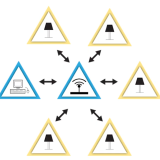
The Lighting Controls Academy is pleased to offer Networked Wireless Lighting Controls, a Lighting Controls Academy course, available as a free video.
Busting Myths About LLLCs
01/02/2026
In this video by the Northwest Energy Efficiency Alliance, two lighting experts bust popular myths about luminaire-level lighting controls (LLLCs).
DLC Offers NLC Training Videos
12/29/2025
The DesignLights Consortium (DLC) offers a free series of training videos covering various aspects of networked lighting controls.