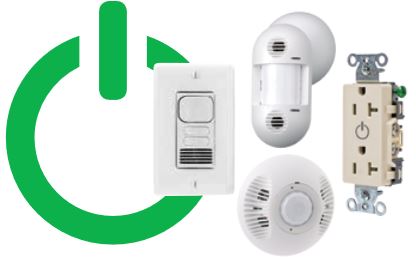
The Lighting Controls Association’s Education Director Craig DiLouie recently interviewed Terry Arbouw, director of business development & product innovation at Hubbell Control Solutions, and Félix Omar Pérez, product manager – energy efficiency at Hubbell Wiring Systems. The topic: automatic plug load control.
DiLouie: What are plug load controls?
Arbouw: Controls for the On and Off state of plug loads – items that are plugged in to outlets rather than hardwired into the buildings electrical systems.
DiLouie: What are the benefits of automation of these loads in commercial buildings?
Arbouw: Office equipment, appliances and plug in lighting loads are the next major area for potential reduction of energy consumption. Today much of what is plugged in to a convenience receptacle is uncontrolled. Turning Off of these loads through automation can provide significant savings and improve safety. For example, consider a breakroom coffee machine that has been left on. The risk of a fire can be reduced if that plug load could be automatically turned off.
DiLouie: Why is plug load control being addressed by the lighting industry?
Arbouw: The concept of this strategy fits in nicely with the lighting industry, which has a long history of providing solutions for automatically turning loads Off when they are no longer in use or needed. Additionally, many plug loads consist of task lights and under cabinet lighting in office cubicles.
DiLouie: What are typical energy savings from plug load control?
Pérez: Plug loads increase energy bills and a building’s carbon footprint. Currently roughly 31 percent of commercial electricity is attributed to plug loads. Energy savings for plug loads vary based on the building, the type of plug loads being controlled and the control strategy being applied. Plug load controls controlling a task light using occupancy control might expect to save as much as 50 percent, while plug load control controlling general use outlets using a scheduling strategy may expect to save much less.
DiLouie: How would you characterize the size of this market? What are typical application?
Pérez: As of April 2017, twenty nine states have adopted an edition of ASHARE 90.1 standard that requires Automatic Receptacle Control (ARC). In theory, a little over half of the United States has adopted a version of the 90.1 standard that has the requirement for ARC. The Building Codes Assistance Project (BCAP) has developed a map that is regularly updated as states adopt the standard. But this doesn’t mean that all 29 states are building under the new standard. For a variety of reasons some states have decided not to incorporate the ARC requirement into respective energy codes.
DiLouie: What are prevailing commercial building energy code requirements relevant to plug load control?
Pérez: ANSI/ASHRAE/IES Standard 90.1, California Energy Commission (CEC) Title 24, Part 6 and Article 406.3(e) of the National Electric Code (NEC®).
DiLouie: What types of plug load controls are available, and how do they work?
Arbouw: Plug loads are generally controlled via a schedule that turns them On and Off based on the day of the week, the time of day or by an occupancy sensor that detects human presence and automatically turn the outlets Off when the space is not occupied.
DiLouie: What are the pros and cons of standalone plug load control versus networking plug load controls into a larger system?
Pérez: Standalone receptacle control, or more correctly localized receptacle control, can prove to be a more reasonable solution because it less likely to cause disruption of the occupant’s daily routine. It is driven by a local time base or occupancy based strategy. As long as the occupant is in the space the loads are energized. A larger networked system would allow time based schedule control and building wide management of plug loads, possibly causing disruption to occupants if not implemented correctly. But this allows for a stricter strategy that could result in bigger savings. The question is not so much the size of the system as it is the appropriateness of the control strategies be used.
DiLouie: What types of larger systems are available that provide room- or building/enterprise-based control?
Pérez: Whether it is Localized, Centralized or Distributed, in either a hard wired or wireless configuration, virtually any lighting control system can provide control of receptacles.
DiLouie: What opportunities exist for electrical contractors and distributors in this market segment?
Pérez: Contractors need to understand local regulations, codes and control strategy and keep themselves informed about the options are available to them in the market. Also, there are important ramifications such as building construction, reutilization of existing control systems that need to be considered when performing a retrofit/renovation.
Because ARC is not a nationwide requirement, distributors will be challenged. They have to rely on regional expertise to make the appropriate decisions to support their local markets. Maintaining inventory is also challenging due to the all of the viable options. Developing an alliance with manufacturers that offer open systems is key to overcoming these challenges.
DiLouie: What are common pitfalls in implementing plug load control, and how can electrical contractors and distributors mitigate them to get the best results for their customers?
Pérez: Avoid the “one size fits all” pitfall. Stay informed about specific local requirements and understand your customer’s goal and strategy to comply with the code or standard. Open and consistent communications with manufacturers and energy efficiency organizations will also help.
DiLouie: If you could tell the electrical industry just one thing about plug load controls, what would it be?
Pérez: There are a number of key factors to consider before selecting the most effective ARC solution for a given space. Make sure you understand the building, its occupants and its use. This will help establish the most appropriate design strategy.