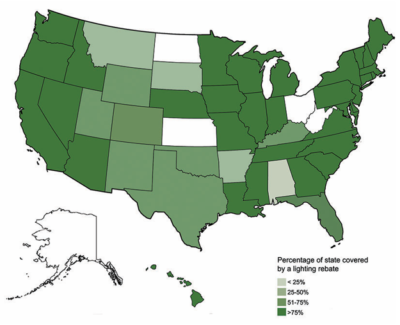
In 2023, commercial lighting rebates remain a strong driver for adoption of energy-efficient lighting and controls in existing buildings. Notable trends include continuing stability in LED and control rebates, imminent jeopardy for some LED replacement lamp rebates, and growth for networked lighting control and horticultural rebates. A coinciding trend with implications for lighting upgrades is introduction of substantial rebates for electric vehicle (EV) charging stations.
Industry journalist Craig DiLouie recently had the opportunity to interview Thomas Leonard, Vice President, Commercial Controls, and Jeff Beyert, Vice President, Channel Sales & Service, of Leviton for an article about lighting control fundamentals to be published in the July 2023 issue of tED Magazine, the official publication of the NAED. The main question is: What does is the minimum every electrical distributor needs to know to begin to understand the lighting controls category?
The DLC recently published a summary of research conducted by Skumatz Economic Research Associates, Inc. (SERA), which identified non-energy benefits (NEBs) of networked lighting controls and developed a methodology for quantifying them.
The Lighting Controls Association is proud to announce the latest offerings in lighting controls from industry-leading manufacturers. Check them out!
A major contributor to the economy is construction, which overall exhibited very strong growth in 2022. Despite a strong finish to the year, however, nonresidential construction spending is expected to moderate in 2023 and slow significantly in 2024, according to the American Institute of Architects (AIA) Construction Consensus Forecast Panel made up of leading economic forecasters. The Panel forecasted that nonresidential construction spending will moderate to grow a healthy 5.8% in 2023 but then slow to less than 1% in 2024.
“Maybe you are on a rushed project with barely enough time to finalize the drawings. Perhaps you’re being onboarded years after the project began. Maybe you just have a client who won’t respond to your requests for more information. No matter the reason, a project without an Owner Project Requirements (OPR) can present one of the most common and difficult challenges modern designers face today.”
The National Renewable Energy Laboratory has published a short guide to plug load control and why it should be a common feature of commercial building energy codes.
The Lighting Controls Association was founded as a council of NEMA back in 2001 to promote adoption of lighting controls through education. Today, the association continues to make a demonstrable difference in supporting public expertise in selecting, designing, installing, and operating lighting control systems. This article outlines the LCA’s accomplishments in 2022 and offers a preview of what’s to come in 2023.
Craig DiLouie, LC, CLCP recently had the opportunity to interview Chris Udall, Senior Project Manager, Lutron Electronics about how electrical distributors can position themselves to sell networked lighting controls.
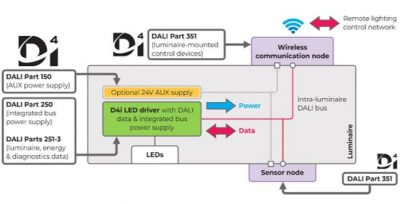
Diagram depicting D4i implementation in an outdoor luminaire with two nodes, one for sensing and the other for wireless communication. Image courtesy of DALI Alliance.
The DALI Alliance recently extended DALI-2, which standardizes interoperability and control of LED drivers and sensors, with a version that more finely addresses the needs of the Internet of Things, which calls for individual device addressability, connectivity, and two-way data exchange.
Craig DiLouie, LC, CLCP recently had the opportunity to interview Martin Mercier, Marketing Manager, IOT/Connected Systems, Cooper Lighting Solutions. The topic: how electrical distributors can position and sell networked lighting controls.
On January 1, 2023, the 2022 version of California’s energy code—Title 24, Part 6 of the Building Standards Code—takes effect, superseding the previous 2019 version. In terms of lighting controls, the numerous changes include various clarifications and tuning along with two major provisions requiring occupant-sensing in offices larger than 250 sq.ft. and demand-responsive lighting controls. Designers and specifiers need to understand these changes before they begin working on code-covered new construction and alteration projects that will go out for permit in California in 2023.

Short throw proximity sensors purposefully activate the scene, to free the light to ripple and move with the pedestrians and cyclists.
This month, we explore a lighting control solution installed as part of a light art installation in a vehicle underpass in Lonsdale Quay, North Vancouver, BC.
The new incarnation of the Commercial Buildings Tax Deduction offers a strong incentive to stretching energy efficiency in new buildings and modernizing existing buildings. In new buildings, it incentivizes more detailed design and the most advanced control options. In existing buildings, it incentivizes a wide range of lighting and advanced control options that, when coupled with available utility rebates, can substantially reduce initial cost that remains the largest inhibitor to investment in reducing operating costs via energy efficiency.
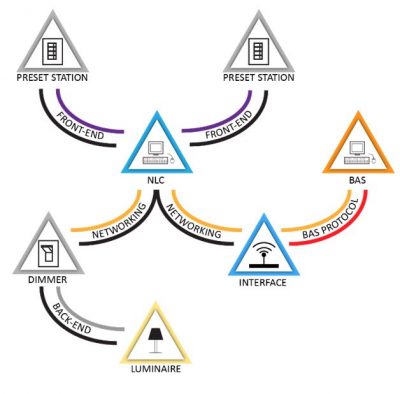
Here’s the scenario: you are a lighting controls designer working on a project with a BAS that uses BACnet…
Craig DiLouie, LC, CLCP recently enjoyed the opportunity to interview Jamie Britnell, Director of Product Marketing, Synapse Wireless for an article about how electrical distributors can sell networked lighting controls to LED upgrade customers, increasing revenues and service value.
The Lighting Controls Association is proud to announce it is now a contributor to LEDs Magazine, a preeminent publication serving the lighting industry. In our first contribution, Craig DiLouie, LC, CLCP authored an article about three hypothetical facility owners/managers using networked lighting controls to achieve a wide range of benefits over the course of a year.
Next year, the 2019 version of ANSI/ASHRAE/IES 90.1, Energy Standard for Buildings except Low-Rise Residential Buildings, takes effect as the national energy reference standard. This is based on a July 2021 Department of Energy (DOE) ruling that determined the standard saved more energy than the preceding 2016 version. By July 28, 2023, all states must adopt a commercial building energy code at least as stringent as the standard, or justify why they cannot comply.
Despite the potential benefits and variety of conditions that tunable lighting systems can provide, research documenting occupant preference in healthcare settings is sparse. Recently, researchers at PNNL and Georgia Institute of Technology’s SimTigrate Design Lab partnered on a study of patient preference for tunable light.
LightNOW’s David Shiller recently interviewed John Arthur Wilson, a lighting control and utility rebate consultant, about his 2021 market research into wireless lighting controls.
In an article recently published in SMART BUILDINGS TECHNOLOGY, LightSPEC Director Clifton Stanley Lemon talks to industry experts about intelligent buildings are the future, while taking a look at current issues with integrating smart building controls.
Many designers, manufacturers, and contractors are resisting change, Marsh notes in his column, and it appears as though we are headed towards a third paradigm shift that will sustain those who adapt and eliminate those who don’t.
As lighting controls become more sophisticated in application and capabilities, properly documenting the system’s intent and settings becomes critical. One of the most important documents is the control narrative, including a detailed sequence of operations. Though required by commercial building energy codes as documentation for many new construction and major renovation projects, aside from the Lighting Controls Association, manufacturers, and a few other sources, there are few resources providing guidance about how to write them. Enter the Illuminating Engineering Society (IES), which took on the challenge by publishing ANSI/IES LP-16-22, Documenting Control Intent Narratives and Sequences of Operations in June 2022.
In senior care centers, tunable LED lighting system retrofits can save energy, reduce operating costs, and improve quality of life for occupants when compared to outdated fluorescent systems that are still used in many facilities nationwide. A recent study suggests that LED tunable lighting system retrofits can offer energy savings and reduced costs, along with the possibility of improved quality of life for residents.
Luminaire-level lighting controls (LLLC), also called embedded controls, are lighting control systems in which sensors and controllers are installed within luminaires to enable autonomous, individual luminaire control. By making each luminaire a control point, control is highly flexible, responsive, and therefore generally more energy-saving. Serving as a preview for an upcoming Education Express course, this article describes LLLC technology, system types, advantages and disadvantages, studies characterizing energy savings and cost, and what’s familiar and distinctive in regards to design and installation.
Modern lighting control systems require a lot more components than they used to. As a result, a lighting controls designer’s job has come to include the documentation required to fully specify a system, which includes well-defined devices, narratives, and sequences. This column by C. Webster Marsh is the first part of a multi-part series that hopes to identify how lighting controls interact with each other and how best to implement a documentation style that is shared with current industry trends.
In this article published in LD+A, Telensa’s Cindy Brewbaker lays out a seven-point case for smart street lighting.
Moderated by Michael Colligan, this episode of Get a Grip on Lighting pits two lighting thinkers in a spirited debate over whether 0-10V or digital lighting control has the edge in projects subject to value engineering.
In this article published in LD+A, the official publication of the Illuminating Engineering Society, Manuel Lopez and Keith Graeber of the California Lighting Technology Center evaluate networked lighting control system metering and reporting capabilities.
Brienne Musselman, Education Director for the Illuminating Engineering Society, looks at seven trends that will affect professional lighting education.
The commercial market lighting rebate outlook for 2022 is even stronger than 2021, with relatively stable, substantial rebates promoting adoption of energy-efficient lighting and controls.
Matt Ochs, senior director of commercial business for Lutron Electronics, recently contributed an article to BUILDINGS Magazine talking about how lighting controls can support the return to the office, either fully occupied or in a hybrid office-home office model.
“With NEMA’s latest guidance on 0-10V control wire colors, I want to dust off an old question: Should the control wires be run in the same conduit as the line voltage wires?”asks C. Webster Marsh.
In 2020, the Illuminating Engineering Society (IES) published ANSI/IES LP-6-20, Lighting Control Systems: Properties, Selection, and Specification. Drawing on the Lighting Controls Association’s Education Express offering as a primary source, this 111-page Lighting Practice and American National Standard provides an excellent foundation for designing with lighting control systems.
In designing and specifying a lighting control system, part of the work involves configuring control zones to meet code requirements. This is an incredibly important step for two reasons…
According to the AIA Construction Consensus Forecast Panel of leading economic forecasters, nonresidential building construction spending is expected to expand 5.4% in 2022 and strengthen to a 6.1% expansion in 2023.
Dan Hollenkamp, COO of Toggled offers several key predictions for the future of smart lighting technology.
In the fall of 2021, the Lighting Controls Association (LCA) invited subscribers of lightingCONTROL, its monthly newsletter, to participate in a survey. The goal of the survey was to determine satisfaction with LCA services.
In this guest post, Jared Morello, VP of Specification Sales, Legrand North America, makes the case that secure lighting networking is achievable with the right compliance and certifications.
While networked lighting controls can deliver significant value in both energy and non-energy benefits, a challenge remains in translating these capabilities to one’s applications. What could be done with greater lighting control in my building? How is the system operated to save energy while deriving other benefits specific to my applications? How could the data be used to benefit my stakeholders? To answer this question, let’s look at three theoretical applications.