On December 2, 2021, PG&E will host a 3.5-hour webinar, “Lighting Controls Success Stories” from 9AM to 12:30PM. In this course, attendees will see case studies demonstrating successful application of lighting controls.


On December 2, 2021, PG&E will host a 3.5-hour webinar, “Lighting Controls Success Stories” from 9AM to 12:30PM. In this course, attendees will see case studies demonstrating successful application of lighting controls.

In his Controls Column contributed to LD+A Magazine in late 2020, Wattstopper’s Charles Knuffke, chair of the Lighting Controls Association, makes the case that energy codes should recognize the non-energy benefits of lighting controls.

Just because 0-10V dimmed luminaires are generally lower cost than digitally dimmed luminaires, it should not be assumed there will be a lower price tag on the overall project, writes C. Webster Marsh.

The U.S. Department of Energy’s (DOE) Integrated Lighting Campaign (ILC) recently interviewed C. Webster Marsh of Penumbra Controls, a lighting controls specialist and frequent contributor to the Lighting Controls Association site.

In a recent LD+A energy column, Willard L. Warren, PE, LC points out that various glare metrics have come and gone, with CIE’s Unified Glare Rating (UGR) on the way. The IES Handbook, however, calls such predictors useful for groups but not for individuals. He poses the question: Is it more practical to simply provide dimmable task/ambient lighting system that’s individually controllable?

In A National Roadmap for Grid-Interactive Efficient Buildings, DOE outlines its national goal to triple the energy efficiency and demand flexibility of buildings by 2030. A subsequent report, published in December 2019, specifically evaluates the potential for lighting and electronics (primarily consumer plus IT equipment) to optimize energy efficiency and comfort while providing services back to the grid. This article examines lighting’s potential to support grid interactivity, primarily in the form of networked lighting controls and automated demand response.

0-10V dimming wires, the wires used to communicate dimming intensity via a 10-volt signal, can be easily identified on wiring diagrams, installation instructions, and dimmable drivers by their colors: gray and violet (although violet is often referred to as purple). This will soon change, however, as new codes and guidelines take effect.

Unless you’ve been living on a deserted South Pacific island prior to March 2020, you know that COVID has been the biggest issue facing mankind in the past year and a half. You also know that lots of people, governments and industries have developed methodologies and technology to mitigate the effects and spread of COVID. What do these things mean for lighting control?

Lighting industry journalist and educator Craig DiLouie, LC, CLCP recently had the opportunity to interview David Buerer, Director of Product Management, Leviton Manufacturing Co., Inc. for an article about plug load control, which will be published in the October 2021 issue of tED Magazine, the official publication of the NAED. Transcript follows.
Most new construction projects have various forms of documentation, but construction documentation often falls into one of two categories: Drawings or Specifications.

In this article published by BUILDING OPERATING MANAGEMENT, building owners and managers are introduced to networked lighting control and shown examples of what pulling data from the system can do to solve business problems.

The Illuminating Engineering Society (IES) recently published ANSI/IES LP-12-21, IoT Connected Lighting. This 43-page Lighting Practice and American National Standard provides guidance for lighting professionals to consider and evaluate connected lighting and Internet of Things (IoT) solutions and applications.

Adoption of networked intelligent lighting control systems is uncertain, with some in the professional lighting community very positive, while others see it as not ready for prime time for themselves or their clients. Putting whether is a problem in definition aside, the question of where networked control is winning or losing is worthy to explore. [...]

In this blog post at Cooper Lighting Solution’s website, Soroush Amidi, Director, Product Management walks you through the cybersecurity standards affecting implementation of intelligent lighting controls and smart buildings.

ux Graphic designer creative sketch planning application process development prototype wireframe for web mobile phone . User experience concept. (ux Graphic designer creative sketch planning application process development prototype wireframe for we
Outcome-based commercial-building energy codes are an idea gaining new interest among policymakers in the United States. This type of energy code prescribes building energy budgets instead of a complex list of requirements. The first efforts started 10 years ago, and we are still years away from a model sure to gain significant adoption. Due to the concept’s potential benefits, however, it is possible, if not likely, that outcome-based codes will be a tool in future energy regulation.
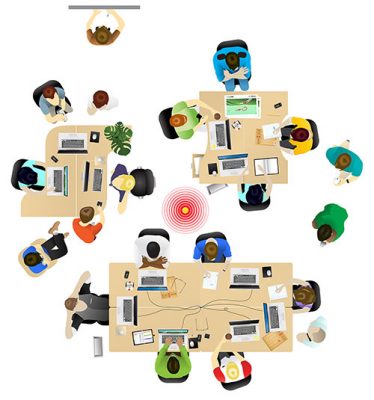
Lighting control design continues to evolve toward smaller control zones for flexibility, energy savings, and responsiveness. This is the topic of the most recent controls column that Charles Knuffke, Systems Vice President and Evangelist for Wattstopper and Chair of the Lighting Controls Association, contributed to LD+A Magazine.

In an article recently published by NEMA, Martin Mercier, Strategic Marketing Manager, Cooper Lighting Solutions talks about the ways in which lighting can contribute to the smart city. Lighting provides infrastructure for data collection, he notes. Standardization and an open ecosystem for partnerships will be key to realizing this opportunity.

In a recent article published by EC&M Magazine, Evergreen Consulting Group’s Tony Adams talks about the evolution of lighting control toward dimming, color tuning, discrete zoning, and application of multiple control strategies in the same space, focusing on luminaire-level lighting controls.
My blog post from April 1, 2020, entitled “Lessons Learned from Living Lab” describes a research project about retrofitting existing spaces with networked lighting control systems (NLCs). It contains recommendations for how to avoid typical of problems that may be encountered on an NLC install. This post will elaborate on some of those “lessons” and recommendations.

ELECTRICAL CONTRACTOR recently ran a roundtable piece in which industry experts identified points of change in the lighting industry. As the Illuminating Engineering Society’s Mark Lien and Lighting Controls Association Chair Charles Knuffke point out, lighting controls are at the forefront of industry change as a leading trend.

The Lighting Controls Association is proud to announce the latest offerings in lighting controls from industry-leading manufacturers. Check them out!
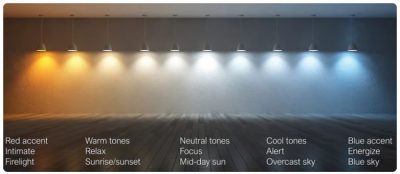
In this article contributed to LEDs Magazine, Lutron’s CRAIG CASEY outlines a specification primer for educating clients on critical concepts that merge dynamic solid-state lighting with controls to optimize wellbeing and enhance the light experience in the built environment. The right equipment and approach, he says, starts with the application needs.

Historically, an inhibitor to adoption of LLLC has been initial cost. An encouraging new study by the Northwest Energy Efficiency Alliance (NEEA) reveals that average costs have been undergoing a steep decline, making advanced controls more attractive for lighting upgrades and new construction.
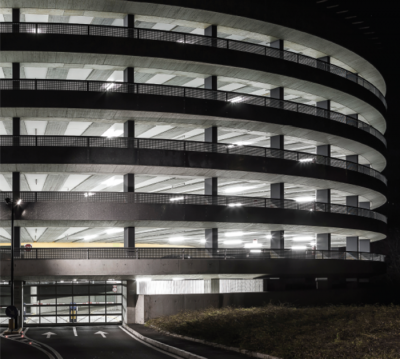
Synapse Wireless has published guidance to achieving best practices and energy code compliance for parking garage lighting control. The guidance describes various relevant regulations and what strategies and equipment are required. “Parking garages can be a challenging environment for lighting designers. From seasonal outdoor daylight patterns, to underground levels, these spaces are a microcosm for [...]

Rebates remain a strong incentive for investing in energy-efficient lighting and controls. In 2021, significant opportunities are widely available for LED lighting and controls, including continuing availability of rebates for networked controls.

In January 2021, the International Code Council published the 2021 version of the International Energy Conservation Code (IECC), which has been updated every three years since 2000. This new version reduces lighting power allowances, expands mandatory controls requirements, and issues clarifications.
In January 2021, the American Institute of Architects’ (AIA) semi-annual Consensus Construction Forecast, a survey of the nation’s leading construction forecasters, projected a 5.7% decline in nonresidential construction spending in 2021. Construction spending is then projected to grow 3.1% in 2022 as the renewal of economic activity unleashes pent-up demand for nonresidential space.

Networked lighting controls may get a boost in adoption by shifting the conversation beyond mere energy benefits, says Liesel Whitney-Schulte and Dan Mellinger.

Image courtesy of OSRAM.
Actually – this isn’t just for electrical contractors! Just about anyone can learn how to commission a networked lighting control system (NLC), writes Steve Mesh.

While “circadian lighting” varies in definition, it generally refers to design that uses intensity and spectrum of light for a non-visual effect—namely, to support regulation of circadian rhythms. A new study suggests that by enabling intensity and spectral adjustment and optimizing exposure based on time of day, designers and owners can minimize the energy tradeoff imposed by associated typically much-higher light levels. This would entail use of an advanced lighting control system capable of scheduled dimming and perhaps spectral emission adjustment.

A U.S. Department of Energy-funded Pacific Northwest Energy Laboratory (PNNL) study found that hospital nurses value controllability in lighting and that this controllability can translate to greater satisfaction among patients.

Jeremy Day, Application Engineering Director for LumenPulse, wrote an interesting article laying out a simple process for designing a lighting control system.
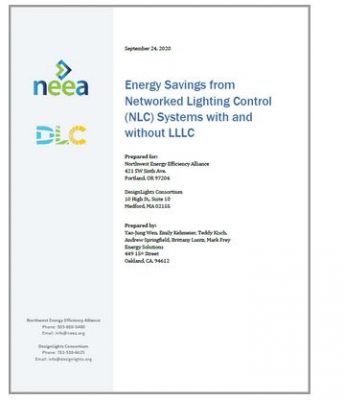
The Northwest Energy Efficiency Alliance (NEEA) and the DesignLights Consortium (DLC) recently released results of a new study that strengthens the case for expanding use of networked lighting controls (NLC) to significantly drive energy savings in commercial and industrial buildings. The report found that energy savings possible by adding NLCs to LED lighting projects approach 70 percent for some building types, with savings across various categories of buildings averaging 49 percent.

The Northwest Energy Efficiency Alliance (NEEA) recently published a study seeking to compare one-for-one luminaire level lighting control (LLLC) retrofits with a comprehensive networked lighting controls (NLC) redesign. Conducted by the University of Oregon, the study found that a one-for-one LLLC upgrade produced comparable energy savings and lighting quality at a competitive cost.
“In my latest education express course, Integration and Building Automation, I discuss basic uses for a Building Automation System (BAS). One use not mentioned is Contact Tracing, which has been brought to the foreground primarily due to the COVID-19 pandemic (also known as Coronavirus). Contact tracing is potentially an essential part of safely re-opening businesses during Coronavirus and since lighting fixtures and lighting controls are necessary wherever people occupy a building, building management can make use of intelligent lighting control systems to improve their contact tracing methods to ensure their occupants are safe.”
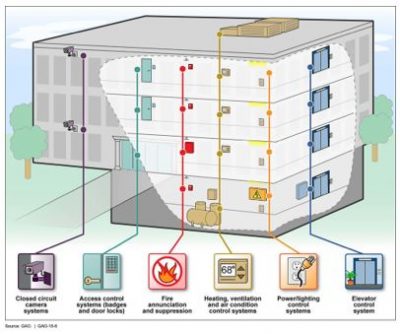
With increasing frequency, lighting control systems are tasked to interoperate with other building systems such as building automation systems (BAS) to share information and automate building functionality. Ensuring communication and smooth interoperability is called integration, a potentially challenging undertaking during a project. This is the topic of a new Education Express course developed for the Lighting Controls Association by C. Webster Marsh, HLB Lighting Design.
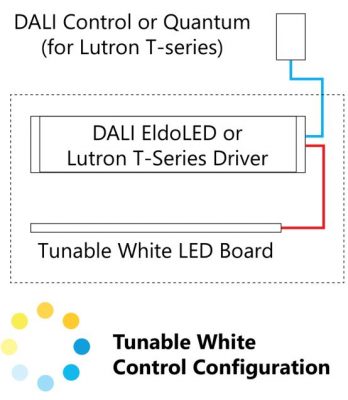
Image courtesy of Axis Lighting
The previous post on Tunable-White Building Blocks talked about differences between using low-level analog control technology as opposed to networked lighting control (NLC) systems that employ digital communication between components. Analog technology such as 0-10V dimmers can in fact be used to control certain color-changing luminaires. Let’s be specific about which types. There are actually three main types of color-changing lighting systems – “dim-to-warm”, “tunable-white”, and “RGB.”
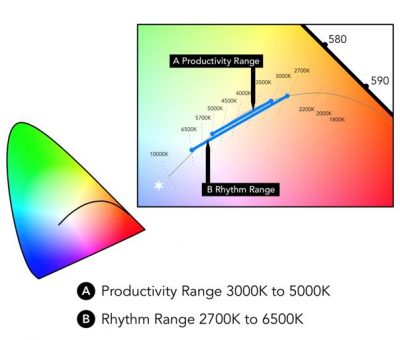
Image courtesy of Lithonia
“Tunable-white and other forms of color-changing lighting have added an extra dimension of capability, flexibility, and complexity to the lighting industry,” writes Mesh. “It’s almost as though we’ve gone from a 2-dimensional world to a 3-dimensional world based on the added complexity of controlling the luminaire’s coloration (typically measured by Correlated Color Temperature ) separately from the luminaire’s lumen output. Don’t be scared! Even though this has exponentially increased the complexity of the equipment and technology, you still don’t need a PhD in lighting to understand this new landscape.”
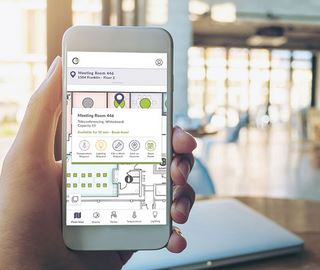
In a recent issue of LD+A, editor Paul Tarricone evaluated three examples of leading-edge control projects, including a Lexus dealership, manufacturing plant, and a corporate office, examining the value today’s advanced controls can deliver to spaces and business operations that go far beyond energy cost savings.

In this article published in LD+A, Chris Davis talks about how collaboration, not technology, is key to implementing smart cities that solve problems and satisfy users.
The Lighting Controls Academy is pleased to offer Lighting Controls and the 2024 IECC, a Lighting Controls Academy course, available as a free video.

After a brief hiatus, the Lighting Controls Podcast is back with a wide-ranging conversation about where the industry stands today. In this episode, hosts C. Webster Marsh and Ron Kuszmar discuss why consistent content matters, where professionals can start learning lighting controls, and why local reps and manufacturers are often the most overlooked educational resources.

The Lighting Controls Academy is pleased to offer Lighting Controls and the 2021 IECC, a Lighting Controls Academy course, available as a free video.

The Lighting Controls Academy is pleased to offer Part 3 of Lighting Control System Design, a Lighting Controls Academy course, available as a free video.

The Lighting Controls Academy is pleased to offer Part 2 of Lighting Control System Design, a Lighting Controls Academy course, available as a free video.

The Lighting Controls Academy is pleased to offer Part 1 of Lighting Control System Design, a Lighting Controls Academy course, available as a free video.
The Lighting Controls Academy is pleased to offer Daylight-Responsive Lighting Controls, a Lighting Controls Academy course, available as a free video.
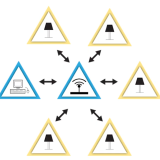
The Lighting Controls Academy is pleased to offer Networked Wireless Lighting Controls, a Lighting Controls Academy course, available as a free video.
In this video by the Northwest Energy Efficiency Alliance, two lighting experts bust popular myths about luminaire-level lighting controls (LLLCs).
The DesignLights Consortium (DLC) offers a free series of training videos covering various aspects of networked lighting controls.


























©2026 Lighting Controls Academy, a coalition of the National Electrical Manufacturers Association. Information published at this website has been obtained from sources believed to be reliable. Damages arising from errors, omissions or damages as from the use or misuse of this information are not the responsibility of NEMA nor its vendors. It is not the intent of this site to provide professional services.
This site rocks with Focus.