Image courtesy of Audacy Wireless Lighting Control
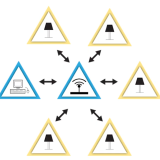
For input devices and luminaire controllers to interact in many applications, a signal pathway is needed. This may be wiring or, more recently, wireless, with control signals sent through the air. This approach eliminates the need for control wiring, resulting in significant benefits, particularly in existing buildings. Using wireless communication, control devices can communicate as discrete devices or as part of networked systems. Click to read this article by Steve Mesh, LC and Craig DiLouie, LC, CLCP.
The second annual Next Generation Lighting Systems (NGLS) indoor competition recently kicked off at The New School, Parsons School of Design in New York City, where a new set of connected lighting systems are being installed in classrooms.
A new exploratory study conducted in the Department of Energy’s Connected Lighting Test Bed investigates energy losses in Ethernet cables used between PoE switches and luminaires in PoE connected lighting systems.
The National Lighting Bureau convened a panel of industry experts to talk about outdoor lighting being used to implement Internet of Things/Smart Cities solutions, part of the organization’s 2017 Annual Lighting Forum. Click to watch this informative discussion.
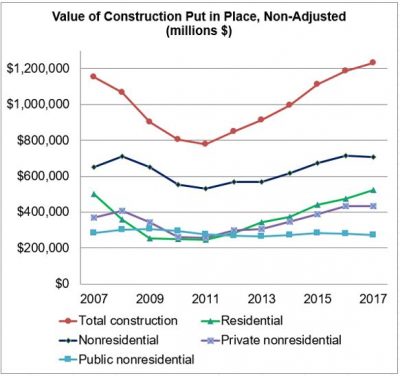
The U.S economy grew by 2.5% in 2017, outpacing 2016, and is expected to produce similar growth in 2018. A major contributor to the economy is construction, and the outlook for construction spending in 2018 overall is positive, particularly nonresidential. The AIA’s semi-annual Consensus Construction Forecast, a survey of the nation’s leading construction forecasters, is projecting 4% growth in nonresidential construction spending in 2018 and 3.9% in 2019.
The California Energy Alliance (CEA) has announced that its code change proposal dedicated to improving the lighting control requirements for lighting alterations was accepted by the California Energy Commission (CEC) in its recently published Draft Express Terms. CEA’s code change proposal includes simplified language with reduced application and/or project-specific requirements; an easy-to-understand energy savings option for small buildings and tenant spaces; and a universal compliance threshold and set of exemptions.
Craig DiLouie recently interviewed Greg Rhoades, Director of Marketing for Leviton Energy Management Controls & Automation, about voice-controlled lighting
This guest article by Steve Mesh compares the pros and cons of room- versus building-based control systems.
While installing controls in new construction or full-scale remodeling is reasonably straightforward, retrofitting controls into an existing building or space can be somewhat problematic, especially when cutting into walls and ceilings is undesirable. To this end, the first step in assessing an appropriate approach is to establish what the goals of a retrofit are. Pure energy savings gains can be realized with simple ON-OFF controls additions, while inclusion of dimming functionality requires greater investment. Embracing more complex targets, such as inclusion of human factors driven lighting strategies are even more involved.
The National Electrical Manufacturers Association (NEMA) and The Industrial Internet Consortium (IIC) agreed to enter a formal liaison to advance the Industrial Internet of Things (IIoT). A liaison relationship between IIC and NEMA fosters common understanding of new technologies for the digital economy.

Image courtesy of Eaton.
Controlling plug loads is a natural fit for the lighting controls industry, as the same devices and strategies are used for automatic shutoff of plug loads such as task lighting as for general lighting. This feature article by LCA Education Director Craig DiLouie, LC, CLCP looks at energy code requirements, compliance options, and control types.
The general concept of the Internet of Things (IoT) is expansive and virtually without limit. The basis of the technology is that devices, appliances, building systems, computer networks, vehicles and personal smart devices become connected together in such a way as to exchange and process information or facilitate integrative control functionality. The impact this will have on industries and individuals is potentially profound.
In this LCA column, Kevin Willmorth looks at the Internet of Things and the role lighting is likely to play in it.
Power over Ethernet (PoE) lighting is part of a brave new world. The ascendance of LED fixtures has given rise to some new methods of providing and controlling light in our environments. Since LEDs are low-voltage devices that use direct current, they are a good match with a system that provides low-voltage DC power over Ethernet cables. Guess what? That’s a computer network! For several years, lighting (and computer) companies have been developing the idea of powering LED fixtures from what is essentially a computer network switch. As you might imagine, this gives rise to a host of questions about a variety of issues.
In this LCA column, Steve Mesh takes an in-depth look at power over Ethernet (PoE) systems.
The TALQ Consortium formally updated its consortium scope to address smart city applications beyond smart outdoor lighting. The new objective of the TALQ Consortium is to extend its standardized software protocol for use between Central Management Systems and generic Outdoor Devices Networks to enable compatibility between systems from different verticals.
Combining LEDs with integrated controls and sensors, luminaire level lighting controls (LLLC) offer customers a single solution that will improve their building, deliver maximum energy savings and enable long-term flexibility. Check out this infographic courtesy of the Northwest Lighting Network …

Distribution of energy savings across the 114 buildings.
The DesignLights Consortium’s (DLC) new report, Energy Savings from Networked Lighting Control (NLC) Systems, estimates average lighting energy savings of 47% resulting from installation of networked lighting control systems. The report indicates high potential energy savings for networked controls, supports layered control strategies as a means to maximize savings, and may be used to justify new and larger utility rebates. Craig DiLouie, LC, CLCP breaks it down in this month’s featured article.
The Lighting Network breaks down basic versus advanced versus networked lighting controls in this short article.

Image courtesy of Eaton
Most commercial building energy codes require automatic lighting shutoff. This common-sense strategy also adds value to lighting upgrades in existing buildings. Remote switching is one method, with an option being switches residing in a metal cabinet-type enclosure called a panel. This panel can serve as the backbone for a complete energy code-compliant control system that responds to a wide range of control inputs for indoor and outdoor lighting control. It is typically sold as a new complete unit, though panelboard retrofit assemblies are available.
This article describes common panel-based lighting control systems.
Republication of Postings from the U.S. Department of Energy (DOE) Solid-State Lighting Program by Jim Brodrick, SSL Program Manager, U.S. Department of Energy A new GATEWAY report on a trial installation of tunable-white LED lighting systems in three Texas classrooms provides valuable insights into the use of this technology in a real-world setting. While reducing [...]
LD+A recently published an article by the California Lighting Technology Center’s Cory Jackson, discussing why commercial lighting remains sparse in demand response programs and what can be done. She writes: After nearly two decades of support and research focused on automated demand response (ADR), lighting remains underutilized as a demand response resource. Beginning in 2007 [...]
In “Connectivity is The Key,” LD+A lighting control columnists Gary Meshberg, LC (chair, Lighting Controls Association) and Craig DiLouie, LC (education director) describe the revolution in lighting controls occurring in the area of connectivity and what this means for the future of lighting. The authors write: While basic connected lighting capabilities have been available for [...]
In May 2016, the DesignLights Consortium® (DLC) released V.1.0 of its Networked Lighting Control Systems Specification, which formed the basis of a new Qualified Lighting Products List (QPL). The intent was to provide utilities and energy efficiency programs a resource to qualify networked lighting control systems so they could be covered in commercial sector lighting [...]
Guest post by Steve Mesh, LC A relatively recent trend in the industry is to embed “luminaire-integrated” (embedded) controls into each fixture. This can be done in different ways, with different types of components, and with different types of control systems. The most basic version of “luminaire-integrated” controls consists of on-board sensors that tell the [...]
Republication of Postings from the U.S. Department of Energy (DOE) Solid-State Lighting Program by Jim Brodrick, SSL Program Manager, U.S. Department of Energy It’s no secret that the explosion of connectivity triggered by the advent of the Internet of Things (IoT) is also impacting the lighting industry — to such an extent as to constitute [...]
The National Association of Innovative Lighting Distributors (NAILD) recently opened registration for its Lighting Specialist-Controls certificate training program. LS-C is a brand-agnostic and technology-neutral training program covering the basics of lighting control that allows distributors to speak to customers and suppliers with competence and confidence. The on-demand, online training program is supported by workbook exercises, [...]
Below is an interview between Craig DiLouie, LC and Manuel Oomen, Senior Director of Product Marketing, Philips Lighting, for an article about luminaire-integrated lighting controls written for tED Magazine. DiLouie: What types of luminaire-integrated controls are available for LED lighting? Oomen: For indoor lighting, integrated controls include presence detectors, (day)light sensors and receivers. For outdoor [...]
The most recent Commercial Buildings Energy Consumption Survey (CBECS) collected new information about lighting control technologies and strategies in the United States in 2012. Compared with other investments in energy efficiency—such as upgrading heating, ventilation, and air-conditioning systems or replacing insulation—lighting controls are often “relatively easy, accessible, and affordable changes,” according to the Department of [...]

Image courtesy of Leviton
Occupancy and vacancy sensors are devices that detect when a space is unoccupied and accordingly automatically turn OFF (or dim) the lights, thereby saving energy. The device may also turn the lights ON automatically upon detecting the presence of people, providing convenience and a potential security aid. According to the Lawrence Berkeley National Laboratory, occupancy-based [...]
Guest post by Steve Mesh, LC Networked lighting control systems are all the rage these days. Rightfully so, given their enormous capability to control luminaires, energy use – and potentially much more. But what are the major elements that define a networked lighting control system? Understanding that will help the specifier to decide which system [...]
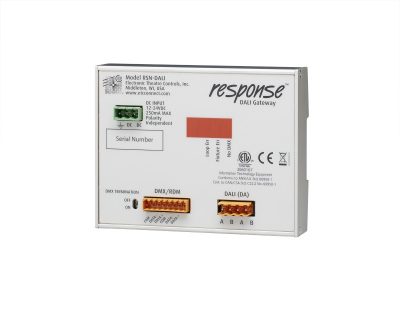
ETC recently announced the addition of the DALI Gateway—which accepts DMX input and outputs DALI protocol—into the company’s line of Response™ products. The DIN-rail-mountable Response DALI Gateway delivers a single loop of DALI control for up to 64 devices and 16 groups. The product allows for the control of DALI Devices to be added to [...]
The 2017 DOE Connected Lighting Systems Workshop was held June 7–8, 2017, in Santa Clara, CA. Now you can download the presentations from the DOE SSL website and discover what the speakers had to say about key issues in connected lighting and what actions are needed to move it forward. Click here to get the [...]
Below is Craig DiLouie, LC’s contribution to the March 2017 issue of tED Magazine. Reprinted with permission. The lighting controls revolution features three notable trends promoting integration of control with light. The latest commercial building energy codes promote complex control schemes. The LED source is highly controllable. And sensors and microprocessors have become miniaturized. Just [...]

Right image courtesy of Schneider Electric.
A good lighting design includes a good controls design. Lighting controls play a critical role in lighting systems, enabling users manually or automatically to: • turn the lights ON and OFF using a switch; and/or • adjust light output up and down using a dimmer. This basic functionality can be used to generate these benefits [...]
The National Electrical Manufacturers Association (NEMA) recently published NEMA 77-2017 Temporal Light Artifacts: Test Methods and Guidance for Acceptance Criteria. Temporal Light Artifacts (TLA) are undesired changes in visual perception induced by a light stimulus whose luminance or spectral distribution fluctuates with time, such as flicker and stroboscopic effect. This new lighting standard makes recommendations [...]
The DesignLights Consortium (DLC) recently released its final Networked Lighting Controls Technical Requirements Version 2.0. Major changes include: • Addition of Exterior System Requirements • Refinement and standardization of definitions and acceptable responses • New reported system information, including API and characteristics, color tuning, start-up and configuration party, and security information Click here to learn [...]
Guest post by Kevin Willmorth, Lumenique In small- and medium-scale lighting application, wired controls remain the foundation for robust controls system architectures. However, the growth of wireless controls is expanding rapidly, and for good reason. The advantages of wireless controls include the ability to move controls and loads and re-assign control-to-load connections without involvement of [...]

Image courtesy of Philips Lighting.
When evaluating an existing lighting system, the owner can do nothing, something or everything. Doing nothing abandons operating cost savings. Doing something entails replacing lamps and installing some automatic controls. Doing everything involves installing a new lighting and control system. As many owners opt for the “something” option, demand for LED replacement lamps continues to [...]
Below is a transcript of an interview Craig DiLouie, LC, CLCP conducted with Gary Trott, Vice President, Marketing, Intelligent Lighting, Cree, Inc. for an article developed for tED Magazine. The topic: luminaire-integrated lighting controls. DiLouie: What types of luminaire-integrated controls are available for LED lighting? Trott: As smart technology continues to expand into our workspaces, [...]
Relying on tunable white light is the “best, most-affordable way to ‘future-proof’ your work and designs and ensure very high performance.” So said Terry Clark, Founder and Chairman of the Board of Finelite, Inc., while participating in the National Lighting Bureau’s Annual Lighting Forum as one of three panelists focused on new and emerging developments [...]
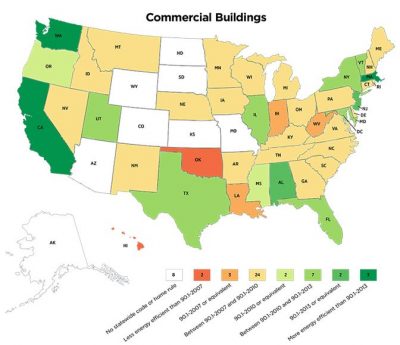
In 2015, the International Code Council published a new version of its International Energy Conservation Code (IECC). This model energy code provides states and jurisdictions code-ready language to adopt in whole or in part. It has been updated every three years since 2000. Today, a majority of states base their commercial building energy codes on [...]