The Lighting Controls Academy has published a video version of EE102A: Occupancy and Vacancy Sensors, a free Education Express course available at YouTube.

The Lighting Controls Academy has published a video version of EE102A: Occupancy and Vacancy Sensors, a free Education Express course available at YouTube.

The Lighting Controls Academy is pleased to announce it has updated its popular Education Express course, EE102A: Occupancy and Vacancy Sensors, now available at NEMA Academy.

In this four-part series, Charles Knuffke, Systems VP & Evangelist, Wattstopper/Legrand, North and Central America and past chair of the Lighting Controls Association provides a crash Lighting Controls 101 class for lighting practitioners.
On January 1, 2023, the 2022 version of California’s energy code—Title 24, Part 6 of the Building Standards Code—takes effect, superseding the previous 2019 version. In terms of lighting controls, the numerous changes include various clarifications and tuning along with two major provisions requiring occupant-sensing in offices larger than 250 sq.ft. and demand-responsive lighting controls. Designers and specifiers need to understand these changes before they begin working on code-covered new construction and alteration projects that will go out for permit in California in 2023.
The Lighting Research Center (LRC) recently published a new DELTA report evaluating new sensor-controlled LED corridor lighting installed in a multifamily residential building in Albany, New York. The project showed significant energy savings while overall occupant response was positive.

Image courtesy of Eaton.
Controlling plug loads is a natural fit for the lighting controls industry, as the same devices and strategies are used for automatic shutoff of plug loads such as task lighting as for general lighting. This feature article by LCA Education Director Craig DiLouie, LC, CLCP looks at energy code requirements, compliance options, and control types.

Image courtesy of Leviton
Occupancy and vacancy sensors are devices that detect when a space is unoccupied and accordingly automatically turn OFF (or dim) the lights, thereby saving energy. The device may also turn the lights ON automatically upon detecting the presence of people, providing convenience and a potential security aid. According to the Lawrence Berkeley National Laboratory, occupancy-based [...]
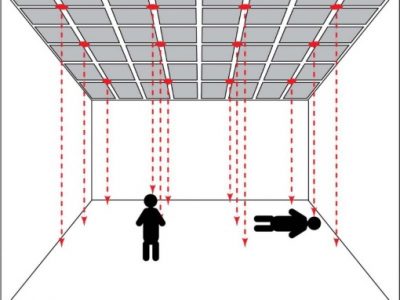
In this rendering, Future smart ceiling panels, each mounted with a single-pixel depth sensor. The red spots represent the position where the ToF depth sensors are mounted, and the dashed lines indicate ToF signals. Image courtesy of Richard Radke.
A team of faculty and graduate students from the Rensselaer Polytechnic Institute Center for Lighting Enabled Systems & Applications (LESA) and Boston University was awarded a U.S. patent titled “Sensory Lighting System and Method for Characterizing an Illumination Space.” The patent describes how the LED lighting system in a space can detect occupants’ presence, location, [...]
The Illuminating Engineering Society, in partnership with the Lighting Controls Association, has published LEM-7, Lighting Controls for Energy Management, a detailed guide to energy-saving lighting controls. The publication was written by Craig DiLouie, LC in support of the IES Energy Management Committee. The 48-page 8.5×11 guide, which is available for $35 (IES members) and $50 [...]
Lighting accounts for about a third of electrical energy consumption in commercial buildings. As advanced energy-saving lighting controls still have a minority penetration in the existing building stock, building owners have a major opportunity to reduce energy costs with lighting control. Adoption of advanced lighting controls faces the usual hurdles affecting all energy-efficient lighting, including [...]
The National Electrical Manufacturers Association (NEMA) has published NEMA WD 7 Occupancy Motion Sensors Standard. Previously published as a guide and not a standard, WD 7 promotes uniformity for the definition and measurement of characteristics relevant to the use and application of occupancy motion sensors. This standard covers the definition and measurement of field of [...]
The National Electrical Manufacturers Association (NEMA) has published LC 1-2007 Test Procedure for Compatibility of Hearing Aids and Ultrasonic Lighting Control Devices. This standard provides a basis to evaluate the possible interactions between ultrasonic lighting control devices and hearing aids utilizing a set of test procedures. This evaluation can be used as the basis for specifying performance criteria for both hearing aids and occupancy sensors to eliminate interference.
What are the benefits of combining advanced lighting control strategies in the same space? Are the energy-saving benefits of lighting controls persistent over time? Can advanced lighting controls be successfully applied to open offices given concerns about jurisdiction conflicts, lighting uniformity, etc.? Can they enhance worker satisfaction? A new office lighting field study addresses these questions. Involving about 90 workers in a real-world open-office environment, the one-year study determined that occupancy sensing, daylight harvesting and individual occupant dimming control worked together in the building to produce average energy savings of 47% while correlating with higher occupant environmental and job satisfaction. The study demonstrates that sophisticated lighting control strategies can be combined successfully to generate persistent, large energy savings in open-plan offices while improving occupant satisfaction with their jobs and workspace.
The Lighting Controls Academy has published a video version of EE102A: Occupancy and Vacancy Sensors, a free Education Express course available at YouTube.
The Lighting Controls Academy is pleased to offer Lighting Controls and the 2024 IECC, a Lighting Controls Academy course, available as a free video.

After a brief hiatus, the Lighting Controls Podcast is back with a wide-ranging conversation about where the industry stands today. In this episode, hosts C. Webster Marsh and Ron Kuszmar discuss why consistent content matters, where professionals can start learning lighting controls, and why local reps and manufacturers are often the most overlooked educational resources.

The Lighting Controls Academy is pleased to offer Lighting Controls and the 2021 IECC, a Lighting Controls Academy course, available as a free video.

The Lighting Controls Academy is pleased to offer Part 3 of Lighting Control System Design, a Lighting Controls Academy course, available as a free video.

The Lighting Controls Academy is pleased to offer Part 2 of Lighting Control System Design, a Lighting Controls Academy course, available as a free video.

The Lighting Controls Academy is pleased to offer Part 1 of Lighting Control System Design, a Lighting Controls Academy course, available as a free video.
The Lighting Controls Academy is pleased to offer Daylight-Responsive Lighting Controls, a Lighting Controls Academy course, available as a free video.
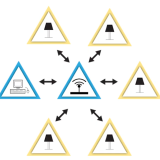
The Lighting Controls Academy is pleased to offer Networked Wireless Lighting Controls, a Lighting Controls Academy course, available as a free video.
In this video by the Northwest Energy Efficiency Alliance, two lighting experts bust popular myths about luminaire-level lighting controls (LLLCs).


























©2026 Lighting Controls Academy, a coalition of the National Electrical Manufacturers Association. Information published at this website has been obtained from sources believed to be reliable. Damages arising from errors, omissions or damages as from the use or misuse of this information are not the responsibility of NEMA nor its vendors. It is not the intent of this site to provide professional services.
This site rocks with Focus.