By Craig DiLouie, LC, CLCP, education director for the Lighting Controls Academy.
Plug-in equipment powered via AC receptacles, ranging from coffeemakers to computers, adds up to one of the biggest and fastest-growing energy consumers in commercial buildings. As such, these loads are attractive targets for reducing energy consumption using automatic shutoff tied to detected occupancy or a predictable time schedule. Numerous energy codes already require this automatic receptacle control.
Controlling these loads is a natural extension of lighting control systems, as the same strategies and devices used for automatic switching of general lighting can be deployed for plug load control at the receptacle or circuit level. Incorporating plug load control for energy code compliance or for an energy-saving upgrade increases the value of lighting control and enhances building energy efficiency.
As with any energy-saving lighting strategy, there are various approaches suitable for different applications, necessitating expertise to make appropriate decisions. In recent years, the National Electrical Manufacturers Association produced a best-practice code-compliance whitepaper and other resources such as guides aimed at owners/designers, building officials, and users. This article summarizes key information in these documents, covering energy code requirements related to automatic receptacle control and strategies for compliance.
Energy codes
Automatic receptacle control has been required by various commercial building energy codes and standards, notably the International Energy Conservation Code (IECC) beginning with the 2021 version, ASHRAE/IES 90.1 beginning with the 2010 version, and California’s Title 24, Part 6 energy code beginning with the 2013 version.
Generally, these codes require at least 50 percent of standard power receptacles (125V, 15A and 20A in IECC and ASHRAE 90.1) to feature automatic receptacle control in designated spaces such as enclosed offices, conference rooms, copy/print rooms, breakrooms, classrooms, and individual workstations (office cubicles).
Additionally, at least 25 percent of branch circuit wiring installed for modular furniture not shown on construction documents must include this type of control.
Any equipment requiring continuous operation or where automatic shutoff would endanger safety or security is exempted.
The automatic power receptacle
The foundation for this control strategy is the automatic receptacle—a receptacle that is either capable of responding to a control signal or is fed by a branch circuit that is capable of responding to the signal.
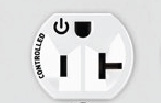 Controlled receptacles must be clearly marked as such by the manufacturer. The National Electrical Code (NEC) requires a marking of “CONTROLLED” plus a power symbol as shown in the example here.
The automatic receptacle may be a fully controlled duplex receptacle, which must be installed typically within a maximum distance from an uncontrolled receptacle, with the distance varying based on code/standard. An example is shown below, in which the receptacles are adjacent. The drawback of this type of installation is that it requires running two circuits and implementing automatic shutoff for every other receptacle.
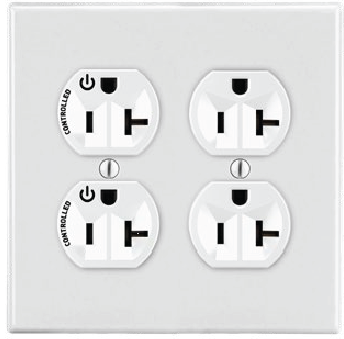
Image courtesy of NEMA.
Alternately, the automatic receptacle may be a split-wired duplex receptacle with one controlled receptacle (the IECC requires it be to the top receptacle as shown in the image below) and one uncontrolled. This allows separate control of plug loads that can be turned Off, such as a computer monitor, and those that must stay On, such as a computer CPU. Installation requires branch circuits that provide the use of two circuits for each duplex receptacle.
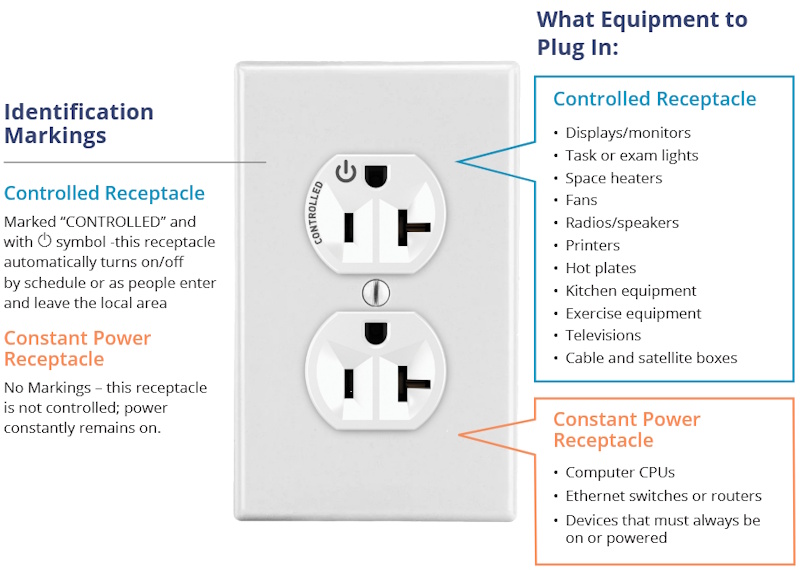
Image courtesy of NEMA.
Note that per the NEC, if a controlled receptacle is being replaced, it must be replaced with an equivalently controlled receptacle.
Strategies for control
As with automatic shutoff for lighting, automatic receptacles may be controlled using one of three methods.
Occupancy: Receptacles are turned On or Off based on occupancy in the controlled area, with shutoff occurring within 20 minutes of vacancy detection per energy codes. Many lighting controls have integrated plug load control capability, with the potential for sensors deployed for lighting control being able to control automatic receptacles. As with lighting control, this plug load control method is most effective in spaces where occupancy varies throughout the day, such as private offices. It can be more cost-effective because it shares the occupancy sensor and control equipment with the lighting control system.
Schedule: Receptacles are turned On or Off based on a predictable occupancy schedule, with independent schedules limited to control zones of a maximum 5,000 sq.ft. per energy codes. Also per codes, the implementation must incorporate override capability (typically up to two hours) for users via a wall switch or a switch on the receptacle itself.
Signal from another building control system: Receptacles are turned On or Off in response to an occupancy-based signal from a security or building automation system. Per energy code requirements, the shutoff signal must be issued within 20 minutes of a vacancy determination.
After deciding which of the methods described above will be used to turn receptacles On and Off, the next decision will be what physical equipment is needed to implement the receptacle control. Examples include a centralized branch circuit control panel, plug load controller, occupancy sensor, room controller, or a directly controllable wall box receptacle. Note that the use of devices such as independently controlled plug-in power strips does not comply with energy codes and standards as they are not permanently installed equipment.
Good, better, best
The “good-better-best” NEMA white paper compares various circuit design methods, notably time-based and occupancy-based control.
For time-based control, a hardwired load controller is placed in series with a branch circuit to implement receptacle load switching on a schedule. The controller could be a remotely controllable circuit breaker at the breaker panel or a controllable relay located outside the panel.
The advantage of this method is it most closely suits current circuit design methods, requiring the fewest changes from a design and installation perspective. The disadvantage is that circuiting and control zoning may not align well, flexibility is relatively limited, and it carries a lower potential for energy savings since control is based on a schedule instead of actual occupancy.
An occupancy-based approach typically uses sensors to incorporate plug load control into lighting control. The advantages of this approach are greater flexibility and potential for energy savings. A potential tradeoff is that to provide the necessary flexibility, this strategy is ideally implemented as close to the individual user level as possible, which requires more circuits. It would also involve more attention to design and installation to ensure a proper match to occupancy usage patterns and schedules.
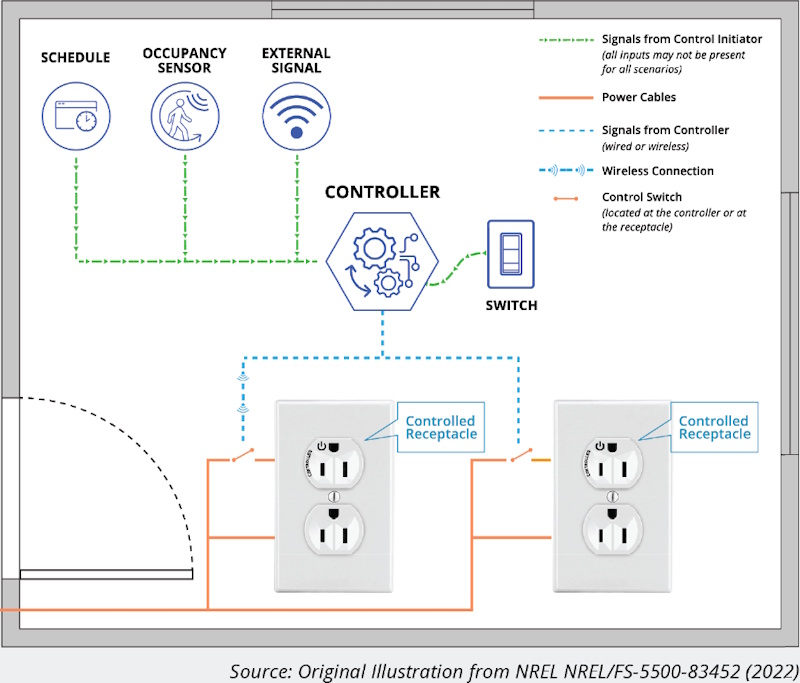
In open offices fitted with workstations (cubicles), a different design can be employed as these need to be controlled as a group. In this implementation, a multiple-circuit control approach could be supplemented with overhead sensors to function as the control signal to turn designated circuit power On and Off.
NEMA emphasizes the importance of ensuring a sufficient number of outlets to serve all users, and that these outlets be located for convenient access.
Technology advances
New technologies have made incorporating occupancy-based receptacle control into lighting control far easier. In particular, control at the individual level is now possible through the use of luminaire-level lighting controls. In addition, wirelessly controlled power receptacles, which can implement both schedule- and occupancy-based control strategies, make design and installation easier while significantly reducing wiring costs.
Plug-load control, which has been required by codes and standards for a number of years, is made easier through the use of lighting control strategies and devices. In addition to code compliance, the implementation of plug-load control increases the value of the lighting control system as a whole and contributes to greater building-wide energy-efficiency.
Get the guidance
Get the NEMA white paper and other guidance here:
Automatic Receptacle Controls to Meet Energy Efficiency Requirements