The TALQ Consortium recently released Version 2.7.0 of its Smart City Protocol, a global interface standard for smart city device networks. The continuous evolution of the protocol ensures that it constantly adapts to changing market requirements.
The new Version 2.7.0 represents a significant step in advancing standardized interoperability for smart outdoor lighting and smart city infrastructures by embracing three important updates. The main highlight is the integration of DALI D4i functionalities, developed jointly in close collaboration with the DALI Alliance and the Zhaga Consortium. The other two updates reinforce consistency within the existing Lighting Profile and increase the flexibility of manufacturers, thanks to vendor-defined events. As before, the updated TALQ Specification (both data model and OpenAPI definitions) is available publicly and free of charge via GitHub.
 Analyzing and prioritizing feedback from cities, utilities, members, partners and other smart city experts to refine and improve the protocol has been an ongoing process since the founding of the consortium. Over the past month, TALQ has included several new functionalities and applied some minor corrections to the protocol standard with the goal of improving and simplifying its use further. The TALQ Specification Version 2.7.0 was officially released in February 2026.
Enhanced data clarity and standard alignment for interoperable outdoor lighting solutions
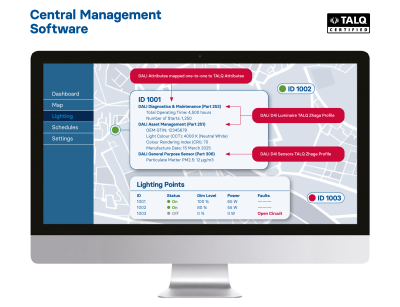
The liaison and coordinated effort among the DALI Alliance, the Zhaga Consortium and the TALQ Consortium strengthen alignment between key international standards and supports consistent, transparent and reliable data exchange in complex multi-vendor system integrations across connected street lighting networks. The new version introduces the two new profiles ‘DALI D4i Luminaire TALQ Zhaga Profile’ and ‘DALI D4i Sensors TALQ Zhaga Profile’. All functionalities defined within these profiles are mandatory.
With a comprehensive, standardized feature set, the new profiles reduce implementation variability and ensure certified products implement a complete, clearly defined scope of functions. The mandatory approach strengthens interoperability by ensuring predictable system behavior across vendors and technologies, providing greater confidence for manufacturers, system integrators, utilities, and cities deploying multi-vendor solutions. The integration of DALI D4i also introduces explicitly defined, source-specific attributes for DALI devices within the TALQ data model. By clearly distinguishing DALI-originated data, Version 2.7.0 enhances semantic clarity and ensures consistent interpretation of device information across systems that may incorporate multiple underlying technologies.
Strengthened requirements for the Lighting Profile
In addition, Version 2.7.0 reinforces consistency within the existing Lighting Profile. The ‘Lamp Actuator’ and ‘Lamp Monitor’ functions will be mandatory for all Gateways implementing the TALQ Lighting Profile – now aligning Gateway requirements with those already established for Central Management Software (CMS). Previously, certification was possible with only one of the two functions implemented.
The Lighting Profile update ensures a complete implementation of essential lighting control and monitoring capabilities, further strengthening the reliability and functional consistency of TALQ-certified systems.
Increased flexibility with vendor-defined events
The new Version 2.7.0 also expands flexibility for manufacturers by introducing support for vendor-defined events, following the structured approach already established for vendor attributes. This enhancement allows vendors to extend their functionalities while remaining fully aligned with the standardized TALQ framework.
The TALQ Smart City Protocol Version 2.7.0 is available to software developers for download via the GitHub repository.
Click here for a list of all officially TALQ-certified products.