For years, commercial lighting rebates followed a simple formula: upgrade to LED, reduce energy use, and collect an incentive. That approach still works, but it’s no longer the full story, says rebate fulfillment firm BriteSwitch. As more markets reach LED saturation, utilities are shifting their focus toward deeper energy savings with lighting controls.
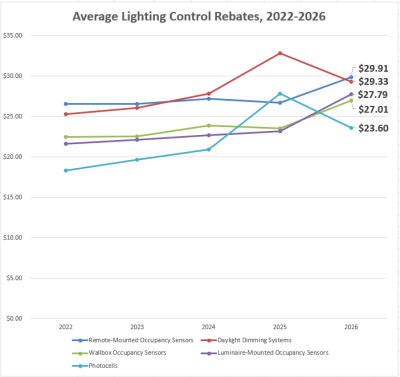
Popular lighting control categories featured in majority of prescriptive commercial lighting rebate programs in 2021-2026, with average rebate amounts per product for programs in the U.S. and Canada. (Networked control systems are not included, as programs are still relatively unstandardized.) Source: BriteSwitch RebatePro for Lighting rebate database, February 2026.
The commercial lighting rebate outlook is strong for 2026, with widely available rebates covering all popular categories of LED lighting and lighting controls, including networked lighting controls.
The Lighting Controls Academy has published a comprehensive update to its popular Education Express course, EE107B: Lighting Controls and Commercial Lighting Rebates in 2026.
The DesignLights Consortium (DLC) has released Draft 1 of its Technical Requirements for Networked Lighting Controls Systems, V5.2 and has invited public comments.

Conceptual example of the Controls Category results when a listed V6.0/LUNA V2.0 product model number is searched for on the SSL QPL.
The DesignLights Consortium (DLC) recently released Version 6.0 of its Solid-State Lighting (SSL) Technical Requirements, the first major update in over five years, as well as Version 2.0 of Light Usage for Night Applications (LUNA), the DLC program designed to promote responsible outdoor lighting. The updates recognize advances in LED technology while promoting controllability as a strong path to energy savings.

Image courtesy of BetterBricks
As the market for replacing traditional light sources with LED becomes more challenging, a new market is developing around upgrade of early-generation LED installations. This presents an opportunity to achieve greater energy savings, enhance lighting quality, and integrate advanced lighting controls. Supported by a small number of new commercial lighting rebates that are likely to expand in availability, this trend appears certain to grow.
The commercial lighting rebate outlook is strong for 2025, with rebates widely available and covering all popular categories of LED lighting and lighting controls. As LED adoption enters what may be the late majority phase, rebate programs are under pressure to deliver energy savings in a more challenging market, resulting in bonus programs and the first signs of stronger promotion of lighting controls.
Whether you use traditional lighting control devices or newer systems such as networked lighting controls (NLCs), you have to communicate and document how you want those devices or systems to behave. This documentation should include a Control Intent Narrative and Sequence of Operations.
While prescriptive lighting rebates have significantly promoted adoption of energy-efficient lighting and controls, the custom rebate option offers a potentially highly lucrative path, particularly in projects with advanced lighting controls.
In the latest episode of the Lighting Controls Podcast co-sponsored by NAILD and the Lighting Controls Association, Jason Jeunnette talks about his work at the Design Lights Consortium (DLC) as a Technical Manager.
The Lighting Controls Association, a council of NEMA, has updated EE107B: Lighting Controls and Commercial Lighting Rebates, a course in the organization’s Education Express program.
In 2024, commercial lighting rebates remain a strong incentive for adoption of energy-efficient lighting and controls in existing buildings. Notable trends in prescriptive rebates include continuing widespread availability, softening demand for rebate dollars, more bonus programs, generally increasing average rebate amounts, and strengthening of networked lighting control rebates.
The DesignLights Consortium (DLC) recently announced the formation of a Horticultural Lighting Controls Technical Working Group that will advise and assist the DLC in efforts aimed at accelerating the horticultural lighting industry’s transition to optimized energy and production practices through networked lighting solutions.
As first-generation LED lighting systems begin to be replaced, a significant opportunity to maximize energy savings by incorporating networked lighting controls is emerging, particularly when HVAC integration is included, according to a new report by the DesignLights Consortium.

Popular lighting control categories featured in majority of prescriptive commercial lighting rebate programs in 2019-2023, with average rebate amounts per product for programs in the U.S. and Canada. Networked control systems are not included, as programs are currently unstandardized. Source: BriteSwitch RebatePro North American rebate database, February 2023.
The Lighting Controls Association (LCA), a council of the National Electrical Manufacturers Association, has released a new and updated version of EE107B: Lighting Controls and Commercial Lighting Rebates as a new course in its popular Education Express program.
In 2023, commercial lighting rebates remain a strong driver for adoption of energy-efficient lighting and controls in existing buildings. Notable trends include continuing stability in LED and control rebates, imminent jeopardy for some LED replacement lamp rebates, and growth for networked lighting control and horticultural rebates. A coinciding trend with implications for lighting upgrades is introduction of substantial rebates for electric vehicle (EV) charging stations.
The DesignLights Consortium (DLC) recently announced the first products added to its LUNA Qualified Products List (QPL) after being tested and determined to meet the new LUNA Version 1.0 Technical Requirements for outdoor LED luminaires.
The Lighting Controls Association now offers EE107B: Lighting Controls and Commercial Lighting Rebates as a new course in its popular Education Express program.
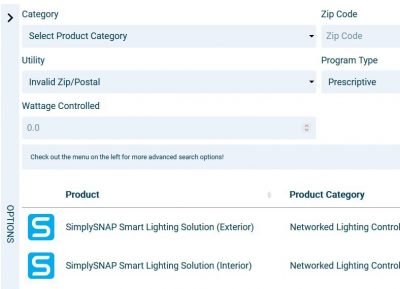
Synapse Wireless, Inc., a member of the McWane family of companies, recently announced an online search tool for locating utility rebate incentives that are available when utilizing DLC 5.0 Networked Lighting Control solutions.
The commercial market lighting rebate outlook for 2022 is even stronger than 2021, with relatively stable, substantial rebates promoting adoption of energy-efficient lighting and controls.
Rebates remain a strong incentive for investing in energy-efficient lighting and controls. In 2021, significant opportunities are widely available for LED lighting and controls, including continuing availability of rebates for networked controls.
Rebate fulfillment firm BriteSwitch recently stated that about 20% of commercial lighting rebate programs are offering additional or bonus rebate opportunities.
Reducing initial cost by an estimated 20-25 percent, rebates remain a strong incentive for investing in energy-efficient lighting and controls. In 2020, significant rebate opportunities are widely available for LED lighting and controls, including growing availability of rebates for networked controls.
Rebate fulfillment firm BriteSwitch recently published a short article on its website about new utility rebates promoting networked lighting controls. Since the introduction of the DLC’s Networked Lighting Controls Qualified Products List, utilities have been trying to decide how to include these control systems in their programs.
In August 2018, the DesignLights Consortium (DLC) released Energy Savings Potential of DLC Commercial Lighting and Networked Lighting Controls, which projects energy savings for LED commercial lighting and networked lighting controls. The report makes a case that to continue getting big energy savings from lighting for another decade, utility rebate program administrators should transition to supporting LED luminaires and networked controls.
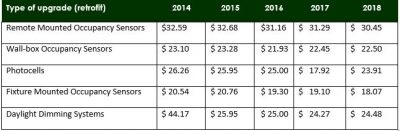
Table 2. Popular lighting control rebates. Source: BriteSwitch North American Rebate and Incentive Database, February 2018.
The most popular lighting control rebates continue to be occupancy sensors, light sensors, and daylight dimming systems. The average rebate for controls is fairly high when one considers their cost, positioning them as an attractive add-on to a retrofit. In some cases, such as high-bay lighting, the rebate can almost completely cover the cost of adding a luminaire-mounted occupancy sensor.
In May 2016, the DesignLights Consortium® (DLC) released V.1.0 of its Networked Lighting Control Systems Specification, which formed the basis of a new Qualified Lighting Products List (QPL). The intent was to provide utilities and energy efficiency programs a resource to qualify networked lighting control systems so they could be covered in commercial sector lighting [...]
By Craig DiLouie, LC, CLCP Many utilities offer incentive programs to customers to get them to use less energy. This is based on the premise that it is often cheaper to pay customers to use less energy than to build new generating capacity to satisfy future power demand. The simplest and most popular type of [...]
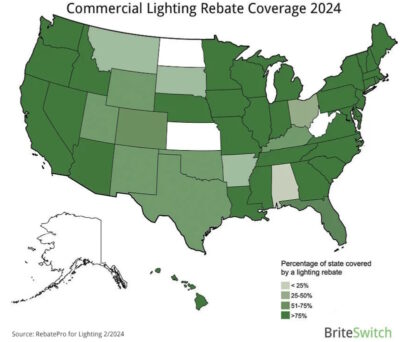
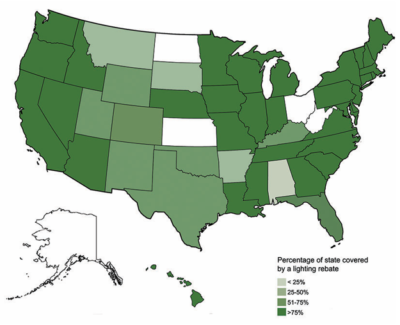
About two-thirds (64%) of the United States is covered by prescriptive lighting rebates, according to BriteSwitch, a rebate fulfillment company. These rebates can significantly reduce the installed cost of new lighting in existing buildings and improve payback by 20-25%, which would reduce a two-year payback to about 1.5 years. Rebates became popular in the 1990s [...]
According to BriteSwitch, for the fifth year in a row, lighting control rebates continue to remain at fairly high, stable levels compared to their costs. For example, current average rebates now available include: * $32.68 for remote-mounted occupancy sensors * $30.30 for fixture-mounted occupancy sensors BriteSwitch reports: “The relatively high rebate amounts (versus the cost), [...]
The DesignLights Consortium recently distributed a letter revising its application process to request information from manufacturers regarding the dimming capabilities of their luminaire, retrofit kit, and linear replacement lamp products for which they are seeking listing on the DLC Qualified Products List (QPL). Edisonreport.net has the story here.
Demand for electricity in the United States has gone up in all but four years since 1949. The Department of Energy predicts growth in capacity of 0.6% per year through the year 2040. Many states and utilities have long considered energy efficiency a resource for satisfying growing demand. According to a study by the American [...]
Utility and regional energy efficiency organization rebates and incentives have been a major driver in demand for energy-efficient lighting and controls since the early 1990s. Today, more than $6 billion in commercial lighting rebates and other incentives are offered by utilities and energy efficiency organizations covering some 80% of the United States. Currently, rebates and [...]