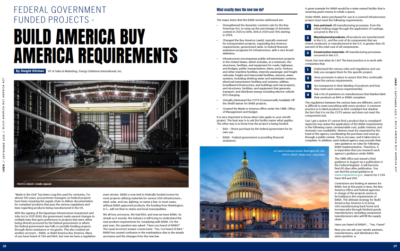
Enacted as part of the Infrastructure Investment and Jobs Act on November 15, 2021, The Build America Buy America Act, or BABA, established a domestic content procurement preference for all infrastructure projects receiving Federal financial assistance after May 14, 2022.
The new incarnation of the Commercial Buildings Tax Deduction offers a strong incentive to stretching energy efficiency in new buildings and modernizing existing buildings. In new buildings, it incentivizes more detailed design and the most advanced control options. In existing buildings, it incentivizes a wide range of lighting and advanced control options that, when coupled with available utility rebates, can substantially reduce initial cost that remains the largest inhibitor to investment in reducing operating costs via energy efficiency.
In September, California passed SB-327, a cybersecurity law that will affect manufacturers of Internet of Things (IoT) and operational technology (OT) devices.
The U.S. Department of Energy (DOE) has issued new energy standards for general-service fluorescent lamps that are expected to reduce availability of standard 4-ft. linear and 2-ft. U-bend 32W T8 lamps as well as some reduced-wattage T8 lamps. The rules go into effect January 26, 2018. After that date, distributors may continue to sell their [...]
The Energy Policy Act of 2005 created the Energy-Efficient Commercial Buildings Tax Deduction (CBTD) to encourage owner investment in energy-efficient building systems. The CBTD establishes a special tax deduction rewarding investment in energy-efficient interior lighting, HVAC/hot water systems and building envelope, subject to a cap of up to $1.80/sq.ft. It’s an accelerated tax deduction, meaning [...]
This month, Federal efficiency standards regulating fluorescent magnetic T12 ballasts entered their final phase, effectively eliminating these ballasts from the market, with few exceptions.
In July 2009, the Department of Energy issued new energy efficiency standards for commercial general-service fluorescent lamps and incandescent (and halogen) reflector lamps. The new rules take effect July 14, 2012 and will basically eliminate products with the lowest efficiency and lowest cost. In the case of fluorescent lamps, equivalent-performance products are readily available, such as T8 lamps, and the market is expected to shift to that and other technologies. In the case of incandescent reflector lamps, only a few equivalent-performance products are readily available that comply, such as infrared-coated halogen lamps, and manufacturers are expected to develop new substitutes.
While general-service incandescent lamps have received the most attention in media coverage of the Energy Independence and Security Act (EISA) of 2007, with provisions beginning to take effect in 2012, many popular incandescent reflector lamps are being outlawed this month.
The Energy Independence and Security Act of 2007 contains significant provisions affecting the sale of metal halide lighting fixtures. Starting in 2009, 150-500W metal halide lighting fixtures must contain ballasts that operate at a certain level of efficiency, virtually eliminating probe-start lamps and ballasts from new fixtures. This provision of the 2007 Energy Act essentially makes a Federal standard of efficiency requirements already enacted in California, New York, Arizona, Oregon, Rhode Island and Washington.
The Energy Policy Act (EPAct) of 2005 created the Commercial Buildings Deduction (CBD), which established an accelerated tax deduction rewarding investment in energy-efficient interior lighting, HVAC/hot water systems and building envelope. Initially set to expire December 31, 2007 and then December 31, 2008, the CBD was recently extended by Congress to expire in five years: December 31, 2013.
The Energy Independence and Security Act of 2007 (HR6) does not include many provisions directly related to lighting. Two of its provisions, however, are nonetheless highly significant. One virtually eliminates the manufacture of today’s >150W to <500W probe-start metal halide magnetic ballasted fixtures starting in 2009 (replacement ballasts are not affected). Another virtually eliminates the manufacture of most common general-service incandescent lamps, putting billions of sockets up for grabs. The Act also has its eye on a possible LED general-service lamp in the future, establishing incentives to develop an LED product that can take on the 60W incandescent.
The Act also distinguishes itself in two other ways. One is what it does not contain, such as encouragement of more-efficient residential energy codes and any tax provisions such as an anticipated extension of the Commercial Buildings Deduction to December 31, 2013. Another is its provisions that may indirectly affect lighting, such as its tough new energy reduction requirements for Federal buildings and the establishment and funding of a Director and Office of Commercial High-Performance Green Buildings, which will work with a private-public partnership to realize a goal of all newly constructed commercial buildings being “net zero energy” by 2030.