The primary legacy source for general lighting in most school spaces is fluorescent. These can be replaced by LED products for 20 to 60 percent energy savings, greater longevity, controllability, and improved quality of light. A lighting upgrade is the ideal time to install advanced lighting controls to enhance energy savings and flexibility in light levels and color.
In senior care centers, tunable LED lighting system retrofits can save energy, reduce operating costs, and improve quality of life for occupants when compared to outdated fluorescent systems that are still used in many facilities nationwide. A recent study suggests that LED tunable lighting system retrofits can offer energy savings and reduced costs, along with the possibility of improved quality of life for residents.
In this article contributed to LEDs Magazine, Lutron’s CRAIG CASEY outlines a specification primer for educating clients on critical concepts that merge dynamic solid-state lighting with controls to optimize wellbeing and enhance the light experience in the built environment. The right equipment and approach, he says, starts with the application needs.
Presented by Craig DiLouie, LC, CLCP, education director for the Lighting Controls Association, this 30-minute webinar provides a deep overview of tunable-white lighting, a relatively new dimension of LED lighting control that is pioneering new capabilities and applications.
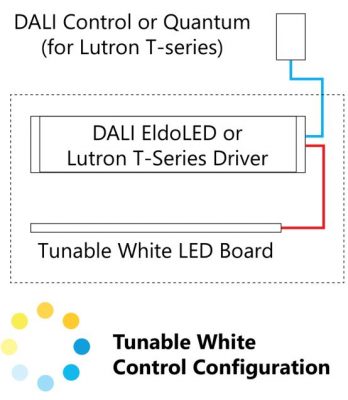
Image courtesy of Axis Lighting
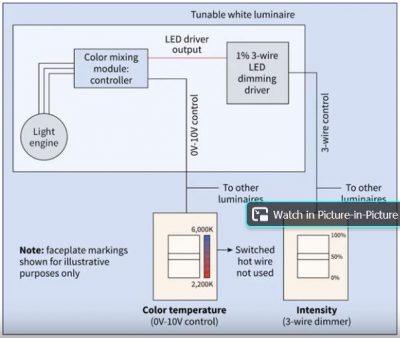
The previous post on Tunable-White Building Blocks talked about differences between using low-level analog control technology as opposed to networked lighting control (NLC) systems that employ digital communication between components. Analog technology such as 0-10V dimmers can in fact be used to control certain color-changing luminaires. Let’s be specific about which types. There are actually three main types of color-changing lighting systems – “dim-to-warm”, “tunable-white”, and “RGB.”
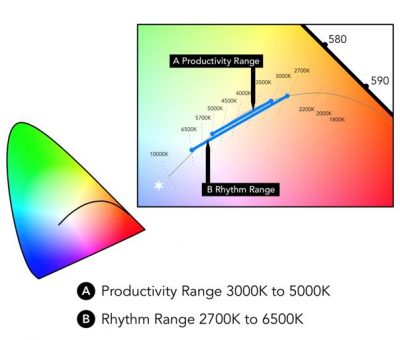
Image courtesy of Lithonia
“Tunable-white and other forms of color-changing lighting have added an extra dimension of capability, flexibility, and complexity to the lighting industry,” writes Mesh. “It’s almost as though we’ve gone from a 2-dimensional world to a 3-dimensional world based on the added complexity of controlling the luminaire’s coloration (typically measured by Correlated Color Temperature ) separately from the luminaire’s lumen output. Don’t be scared! Even though this has exponentially increased the complexity of the equipment and technology, you still don’t need a PhD in lighting to understand this new landscape.”
On June 4 at noon EST, the Illuminating Engineering Society will host a free webinar, “Show Me the Data: Characterizing the Performance of Color Tunable Light Sources.”
BOM Magazine recently published an article advising building owners and managers about how to select the right tunable-white lighting solution for their buildings. Written by Craig DiLouie, LC, CLCP, education director for the Lighting Controls Association, the article covers applications and benefits, theory of operation, types, typical approaches, protocols, and application considerations.
In this guest post by lighting designer C. Webster Marsh, he discusses alternatives to using DMX512 to control tunable-white lighting.
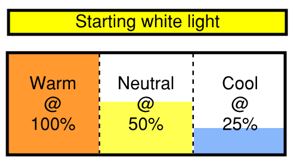
DMX512-controlled tunable dynamic white luminaires are luminaires that use DMX512 controls to change their correlated color temperature (CCT) on demand, which provides a dramatic design tool to the modern lighting designer. These luminaires are different from dynamic color changing luminaires because instead of using colored LEDs, they use a mix of white LEDs such as warm white, neutral white, and cool white. When these hues are mixed at different intensities, the overall delivered CCT of the luminaire changes. It is very important to have a robust controls system specifically designed and programmed for the control of tunable dynamic white luminaires. Any compatible controller will control a DMX512 tunable white luminaire and can adjust from one hue to another, but that’s only half the story …
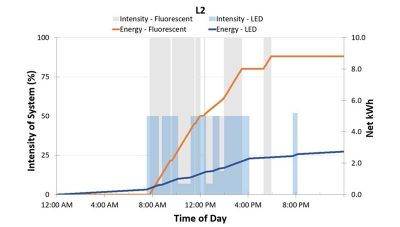
Comparison of intensity and energy consumption of the fluorescent and tunable-white LED systems on a typical day in Classroom L2.
Tunable-white LED lighting offers highly efficient general illumination combined with dimming and the ability to tune correlated color temperature (CCT) from warm- to cool-white. A strong potential application is classrooms, where teachers can set lighting/visual conditions to support classroom activities. In May 2019, the Department of Energy (DOE) published a Pacific Northwest National Laboratory (PNNL) report evaluating a trial installation of tunable-white lighting systems at three classrooms in an elementary school in Folsom, California.
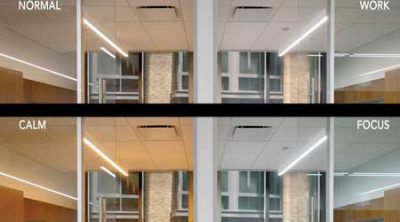
Hubbell’s Summer Albergotti and Marissa Keisler contributed an article to Facilities.net, “Human-Centric Lighting for Schools, Hospitals, and Offices.” The article describes how color tuning enables lighting systems to better serve the needs of users and spaces.
Republication of Postings from the U.S. Department of Energy (DOE) Solid-State Lighting Program by Jim Brodrick, SSL Program Manager, U.S. Department of Energy A new GATEWAY report on a trial installation of tunable-white LED lighting systems in three Texas classrooms provides valuable insights into the use of this technology in a real-world setting. While reducing [...]
Relying on tunable white light is the “best, most-affordable way to ‘future-proof’ your work and designs and ensure very high performance.” So said Terry Clark, Founder and Chairman of the Board of Finelite, Inc., while participating in the National Lighting Bureau’s Annual Lighting Forum as one of three panelists focused on new and emerging developments [...]
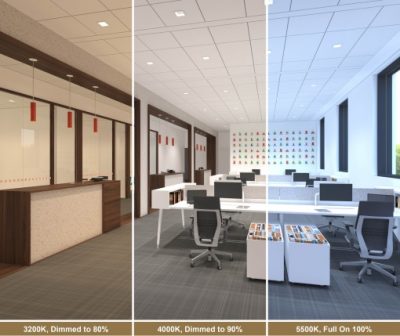
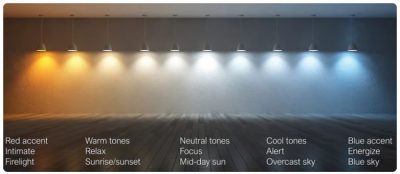
Tunable-white lighting allows manual or automatic adjustment of a luminaire’s shade of white light, which opens a wide range of application possibilities. Image courtesy of USAI Lighting.
Guest post by Steve Mesh, LC Because of recent trends in the lighting industry, it is now possible to “dial in” a desired color temperature in certain light fixtures at specific times of the day or night. One of the main trends making this possible is the mixture of different color LEDs in architectural fixtures. [...]
Craig DiLouie, LC recently had the opportunity to interview David Ciccarelli, VP Dynamic Lighting, Acuity Brands Lighting, Inc. The topic: tunable-white lighting. DiLouie: Looking at LED sources and controls, what are the different technological methods used to produce tunable-white light in commercial luminaires? Ciccarelli: The goal of Tunable White lighting is to reproduce multiple color [...]
Light is comprised of wavelengths that the human eye interprets as colors. For an object to be perceived a certain color, that color must be present both in the light striking an object and the object reflecting the light towards the observer’s eye. Because of this, the choice of lamp for white-light general lighting can [...]