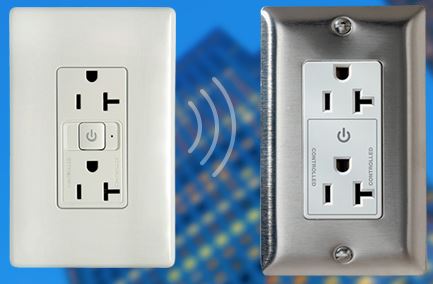
Craig DiLouie recently interviewed David Kaminski, Product Marketing Manager at Legrand, for an article about plug load control for an article in ELECTRICAL CONTRACTOR.
DiLouie: What are plug load controls? What are the benefits of automation of these loads in commercial buildings? (And why is plug load control being addressed by the lighting industry?)
Kaminski: The amount of power consumed by devices connected to the 120VAC receptacles has been identified as a key opportunity for savings. What the controls industry is now doing is extending the strategies that have been effective in turning lights off when not necessary to also control receptacles. Both occupancy sensors and time clocks can be easily used to control a select group of receptacles in a space off when they are no longer needed. The use of these controls for both lighting and plug load is the reason that most folks associate plug load controls with lighting, especially since it is the same electrical engineer that is responsible for specifying both for the project.
The U.S. Department of Energy (DOE) estimates that plug and process loads account for one-third of energy use in commercial buildings. The percentage of power used by plug loads is larger than ever before and smart building owners and energy codes are looking at plug loads as a key opportunity for future savings.
Commercial office: Cut power to monitors, printers, space heaters and more when not in use.
Code-driven applications:
ASHRAE 90.1: private offices, conference rooms, print/copy rooms, break rooms, individual work stations
Title 24: private offices, open offices, kitchenette areas, reception lobbies, copy rooms
Hospitality: Shut off appliances when room becomes vacant.
Code-driven applications:
Title 24: hotel/motel guest rooms
Education: Eliminate vampire loads in computer labs.
Code-driven applications:
ASHRAE 90.1: classrooms
Title 24: computer classrooms
DiLouie: What are typical energy savings from plug load control?
Kaminski: According to the DOE, office equipment is still projected to be the fastest-growing use of energy between 1998 and 2020. A breakdown shows that plugs and process loads command 33 percent of energy use and are projected to grow by 49 percent by the year 2030.
DiLouie: How would you characterize the size of this market? What are typical applications?
Kaminski: So what types of devices should you target for plug load control? Well, for starters you’ll want to control the big energy hogs that will quickly impact your bottom line, such as printers, copiers, space heaters, water coolers, and task lights. Other devices to consider for plug load control include coffeemakers, microwaves, televisions, and vending machines. While individually it’s hard to imagine these devices sapping much energy when not in use, you’ll likely be surprised by the combined savings right away.
DiLouie: What are prevailing commercial building energy code requirements relevant to plug load control?
Kaminski: The approach the energy codes take is to require plug load controls be installed in certain spaces – usually as a percentage of all receptacles, or ensuring that a controlled receptacle is within a specified distance from other receptacles without controls.
ASHRAE standards require that 50 percent of receptacle loads to be controlled by automatic means. Currently, nearly half of the states have either written codes based on this standard or have seen the ASHRAE 90.1 standard as an acceptable means of compliance, so it’s important to know what has been approved in your local market.
Section 8.4.2 of ASHRAE 90.1-2010 mandates that 50 percent of 15- and 20-amp, 125 VAC receptacles are to be controlled in private offices, open offices, and computer classrooms. The 2013 revision of ASHRAE 90.1 expands this scope to reception lobbies, conference rooms, kitchenette areas, copy rooms, and hotel/motel guest rooms.
Going further, ASHRAE 90.1 mandates that controlled receptacles must be permanently differentiated from uncontrolled receptacles. Other codes and standards weigh in on this requirement as well; for instance, in Article 406.3(e) of the 2014 NEC®, controlled receptacles must have the NEMA-approved power symbol (shown to the right) visible on the outlet after installation. We highly recommend installing receptacles with this permanent marking in place, direct from the manufacturer. Other methods, such as adhesive label stickers, present more of a risk at inspection time, and can be misapplied, misoriented, and scratched off over time. Additionally, the use of receptacle colors is a helpful way to help tenants in a space determine which receptacles provide power 24/7 versus those that will shut off automatically.
California facilities are bound to the state energy commission’s Title 24 regulation, which is the most stringent energy code enforced nationwide. Specific to plug load control, Section 130.5(d) of Title 24 (2013) mandates that at least one controlled receptacle must be within six feet of an uncontrolled receptacle in the following spaces: private offices, open offices, kitchenette areas, reception lobbies, conference rooms, copy rooms, and hotel/motel guest rooms. This controlled receptacle requirement can be achieved using split-wired receptacles.
DiLouie: What types of plug load controls are available, and how do they work?
 Kaminski: The most prevalent products include Tier 1 and 2 advanced power strips or wall receptacles.
Advanced power strips can work with an occupancy sensor that controls a position of the receptacles. Keep in mind power strips are not considered to be permanently installed devices, and therefore cannot be used to meet energy code compliance. For code compliance, controlled receptacles can have their power controlled with power packs connected to occupancy sensors or through wireless communication from a control system.
Plug receptacles can be fully controlled or half controlled. A fully controlled device will completely turn power off based on occupancy. A half-controlled device will turn off the controlled receptacle while leaving the other uncontrolled device turned on. This allows you to keep essential devices like refrigerators, clocks, charging stations and CPUs plugged in, while turning off toaster ovens, water coolers, space heaters, monitors, printers, etc.
DiLouie: What are the pros and cons of standalone plug load control versus networking plug load controls into a larger system?
Kaminski: Networked controls allow you to tie into lighting control networks. This can include networking, scheduling as well as real-time power monitoring analysis and visualization.
Networking also allows scalability. As more electrical devices are moving towards IOT, the ability to network and scale with a digital or wireless system allows facility managers to create IoT device lifecycle management strategies.
Both networked and standalone plug load controls are easy to install.
Some companies also offer code compliant solutions with wireless signal transmitters and RF receptacles, which are controlled via occupancy sensing and can easily be bolted onto the lighting controls system in the space. The wireless transmitters serves as a means for communication between an occupancy sensor and the plug load RF receptacle, which typically boast a UL-approved relay suited for switching 20-amp circuits and can feed through to control an entire circuit. This product may be compatible with any 24 VDC analog sensor and power pack and also can communicate with digital systems.
Plug load timer receptacles are even simpler, and offer control via timer/schedule as a standalone product that is easy to install and perfect for retrofits. As part of the building strategy, don’t just focus on the wall. The ratio of outlets in the floor versus wall is surprising. Poke-thru devices and floor boxes that have been successfully tested to control Plug Load RF Receptacles from up to 30 feet.
DiLouie: What types of larger systems are available that provide room- or building/enterprise-based control?
Kaminski: Integrating with Relay Panels allow time based control of your building. This allows you to turn off lighting loads, as well as plug loads based on:
Using stand alone components –
Option 1 -Hard wire the receptacle to sensors and power packs and occupancy based ceiling or wall occupancy sensors.
Option 2 – Attach a RF signal pack to a ceiling sensor. The RF signal pack will wirelessly communicate with RF receptacles to turn off the plug load based on vacancy of the space.
Using digital management systems –
This provides variety of capabilities and flexibility by integrating with other building systems. This can include networking, scheduling as well as real-time data analysis and visualization.
DiLouie: What opportunities exist for electrical contractors in this market segment? What do they need to know to install and sell appropriate solutions to their customers?
Kaminski: For new construction, it’s not so much an opportunity as a requirement if a contractor is doing work in an area where plug load control is mandated. Future-ready a building as much as possible by identifying and installing flexible solutions to accommodate space reconfigurations. Look for scalable, “retro-fittable” systems and keep plug load devices accessible for quick use when needed. For instance, power packs that are buried behind a wall or in a ceiling and hard-wired into the electrical circuit are not as future-ready as wiring devices that have plug load control relays inside of them; the latter can be easily moved around with future space reconfigurations and are easy to retrofit and maintain.
DiLouie: What opportunities exist for electrical distributors in this market segment? What do they need to know to recommend and sell appropriate solutions to their customers?
Kaminski: Have an in-house expert. Leaving sometimes-confusing code navigation to an expert, especially with the California Energy Commission Title 24 regulation or someone who knows the local codes, is a good idea. An expert will also help to avoid costly rework due to code confusion.
DiLouie: What are common pitfalls in implementing plug load control, and how can electrical contractors and distributors mitigate them to get the best results for their customers?
Kaminski: Just as a building needs to remain current with product and services, so do building owners and facility managers. It’s best to try and stay ahead of code adoption to ensure your building is compliant. This will assist in both recognizing and calculating the savings potential in dollars.
DiLouie: If you could tell the electrical industry just one thing about plug load controls, what would it be?
Kaminski: This is the next evolution of energy savings.
DiLouie: Is there anything else you’d like to add about this topic?
Kaminski: Many building owners and facility managers are still unaware that this type of energy control is available. The change is being driven by the latest code updates. It’s an easy and affordable energy saving solution for new construction and renovation projects.