by Craig DiLouie, LC, CLCP, Education Director, Lighting Controls Academy
 The American Society of Heating, Refrigerating, and Air-Conditioning Engineers (ASHRAE) and the Illuminating Engineering Society (IES) recently published ANSI/ASHRAE/IES Standard 90.1-2025, Energy Efficiency Standard for Buildings Except Low-Rise Residential Buildings.
This edition incorporates 105 addenda that advance energy efficiency and expand compliance options. For lighting, the 2025 version reorganized the lighting requirements, updated LPD values, revised exterior lighting zones, and strengthened lighting control requirements.
This article examines the 2025 revision, focusing on salient changes. Note that this information is provided for educational purposes only and does not constitute a definitive interpretation. For more information (such as details and exceptions) and interpretations, consult the standard or the applicable Authority Having Jurisdiction (AHJ) where the standard is enacted as the basis of code.
About Standard 90.1
Commercial building energy codes regulate the designed energy efficiency of nonresidential buildings. A majority of states rely on model energy codes and standards such as ANSI/ASHRAE /IES Standard 90.1 and the International Energy Conservation Code (IECC).
While a majority of codes are based on the IECC, Standard 90.1 is:
• recognized by the U.S. Department of Energy as the federal reference code (currently the 2022 version is in effect, but all states are required to adopt a code at least as stringent as this version by mid-2026 or justify why they cannot comply, so as to receive federal enforcement funding);
• the basis for building rating systems such as LEED; and
• recognized for use by the IECC as an alternative compliance standard.
Like the IECC, Standard 90.1 is published with updates every three years.
For lighting, energy codes typically impose a mix of prescriptive and mandatory requirements, the latter largely focused on lighting controls. Since 1999, the overall trend has been toward lower lighting power allowances and more detailed control requirements to maximize energy savings. The 2025 version of 90.1 is no exception.
Lighting scope
Standard 90.1’s lighting requirements cover new buildings, additions, and exterior lighting serving a building, as well as certain alterations with exceptions. The 2025 version expanded its scope to include lighting equipment and systems on sites independent of a building. This expanded scope included clarifying exceptions for public street and roadway lighting, including traffic signage lighting and other lighting in the public right-of-way.
Lighting power
Standard 90.1 limits maximum lighting power density (LPD), expressed in W/sq.ft. Typically, lighting designers can choose one of three compliance paths:
• Simplified Building Method, restricted to certain building types under 25,000 square feet.
• Building Area Method, which poses a single maximum lighting power allowance for the entire building.
• Space-by-Space Method, which details a maximum power allowance for each space type within the building.
Note that certain types of lighting may be exempted from calculated LPD but must still comply with certain requirements, including lighting control requirements.
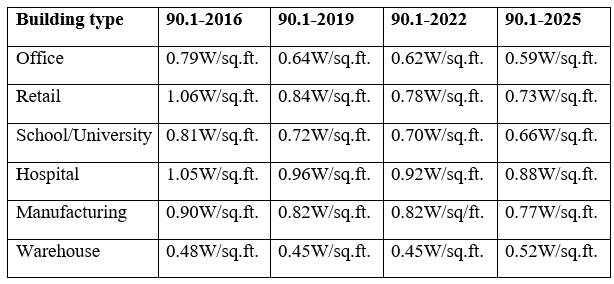
The 2025 version of 90.1 adjusts interior lighting power allowances largely downward, in recognition of the ability to save energy and produce satisfactory lighting quality using available technology. Below are several examples of interior LPD allowances using the Building Area Method, showing a 5-10 percent reduction compared to the 2022 version (except for Warehouse buildings).
In addition to interior lighting, Standard 90.1 also caps exterior lighting power using a system of base allowances and tradable surfaces. The 2025 version significantly reduces both parameters as compared to the previous version.
Horticultural lighting
The 2022 version of Standard 90.1 added a section addressing the distinct characteristics of horticultural lighting. Certain horticultural luminaires must achieve a minimum photosynthetic photon efficacy (PPE) and be controlled by a device that automatically turns them Off at specific times. The 2025 version increased the required PPE of these luminaires.
Decorative and retail power allowances
When using the Space-by-Space Method, an increased LPD is allowed for lighting used for specific purposes such as decoration (decorative lighting or to highlight art or exhibits that are not exempted by the standard) or for supporting retail sales.
The 2025 version of Standard 90.1 decreases the additional interior lighting power allowance for decoration lighting from 0.70W/sq.ft. to 0.50W/sq.ft. It also created an additional lighting power allowance of 1.0W/sq.ft. for interior exit stairways to coincide with increased stairway illumination required by newer versions of the International Building Code (IBC).
Outdoor lighting zones
Exterior lighting power allowances are set based on lighting zones, which reflect population density. The 2025 version of 90.1 revises these lighting zones to align with current IES recommendations.
Lighting controls
Standard 90.1 contains detailed mandatory lighting control requirements for each space type applicable to the Simplified Building Method, the Building Area Method, and the Space-by-Space Method. These space types are listed in tables alongside required and optional control strategies, the requirements for which are described in detail along with various exceptions and specifics.
Local control: This is generally required in spaces. Where applicable, one or more manual control devices must be installed that provide On/Off control of all lighting. Control zoning is limited to 2,500 sq.ft. if the space is 10,000 sq.ft. or limited to 10,000 sq.ft. for larger spaces.
The device must be readily accessible to occupants and allow them to see the controlled lighting—unless an exception is made for safety or security, in which case remote, clearly labeled devices with indicator lights can be installed.
Manual- and partial automatic-On: In a majority of spaces, the designer is given a choice of whether the lighting system will turn On manually or automatically. In detail, the two options are:
• manual-On (none of the lighting automatically turns On); or
• partial automatic-On, where no more than 50 percent of the general lighting power may be automatically turned On, with the other 50 percent being turned On manually.
In some spaces, such as storage rooms, manual-On operation is specifically required, with no option for partial automatic-On.
Multilevel lighting control: Multilevel lighting control, for which the occupant is given the ability to adjust a desired light level, is required in many spaces such as offices, dining areas and lounges/breakrooms.
Where required, the general lighting must be manually controlled with continuous dimming (100-10 percent or less of lighting power) in addition to On/Off.
Occupancy sensor controls: Standard 90.1 requires that general lighting be reduced or turned Off when not in use, with few exceptions. Automatic shutoff may be achieved with controls that adjust the lighting in response to occupancy or a programmed schedule.
In many smaller enclosed spaces such as private offices, storage rooms, and restrooms, occupancy sensors are specifically required. In a majority of these spaces, the occupancy sensor must turn the lights completely Off, with control zoning limited to 5,000 sq.ft. per sensor. In some spaces such as corridors, where the lights may remain On in vacant spaces for safety reasons, lighting power must instead be reduced by at least 50 percent.
In the 2022 version of Standard 90.1, sensors were required to change the lighting within 20 minutes of a space being vacated. In the 2025 version, this has been reduced to 15 minutes.
Occupancy sensors in large offices: In offices larger than 300 sq.ft., a specific approach to occupancy sensors is required, with significant adjustments in the 2025 version. Sensors must be installed with an average control zone of 600 sq.ft. per sensor and no single control zone can exceed 900 sq.ft.
Below is a basic sequence of operations:
• When an occupant enters a control zone, the lighting may automatically turn On at full power, while the rest of the office lighting may operate at no more than 20 percent or less of full power.
• Within 15 minutes no occupancy detected in a control zone, the controlled lights must be turned Off or uniformly reduced to 20 percent or less of full power.
• Within 15 minutes of the entire office being vacated, all general lighting must turn Off.
Scheduled shutoff: All lighting is turned Off when the space is predictably unoccupied, either in response to a time-of-day control device or a signal from another building system.
Control zoning for scheduled shutoff control is limited to 25,000 sq.ft. and a single floor. The control system must be programmed for weekend/holiday operation. Any manual override control is limited to 5,000 sq.ft. control zoning and an override period of two hours per override activation.
Lighting power reduction: Occupancy sensor-driven power reduction is now required in atria with ceiling heights below 20 ft.
Power reduction is also required in transportation facility concourses and passenger loading areas by occupancy sensor control when ceiling heights are 15 feet or less. When ceiling heights exceed 15 feet, lighting power may be reduced via occupancy sensors or schedule-based controls.
Finally, spaces adjacent to patient care areas in health care facilities, require power reduction based on a schedule coinciding with night operation hours.
Daylight-responsive controls: General lighting in daylight areas is required to include daylight-responsive controls that independently control the lighting, with exceptions. These daylight areas are defined by whether they are sidelit (adjacent to vertical fenestration such as windows) or toplit (under fenestration such as skylights), with sidelit areas divided into primary (directly adjacent to fenestration) and secondary (directly adjacent to primary) areas.
If the total wattage of general lighting in the primary sidelit area, whether entirely or partially, is 75W or greater, daylight-responsive control is required. In the 2025 version, if the total general lighting wattage in the secondary sidelit area is 75W or greater, independent daylight-responsive control is also required.
In sidelit zones, the daylight-responsive controls will reduce lighting power in response to daylight using continuous dimming to <10 percent plus Off (as compared to <20 percent plus Off in the 2022 version).
For toplit daylight areas, if the total wattage of all general lighting either entirely or partially in a daylight area under skylights and roof monitors is 75W or greater, daylight-responsive control is required. The daylight-responsive control must reduce lighting power in response to daylight using continuous dimming to <20 percent plus Off.
Exterior lighting controls: In a majority of applications, lighting must be automatically turn Off when sufficient daylight is available or within 30 minutes or sunrise. For building facades, the shutoff may be implemented on a schedule between midnight or business closing (whichever is later) and 6AM or business opening (whichever is earlier).
A significant number of applications also require a 50 percent reduction in lighting power when the area is not occupied. This may be implemented either by using a schedule-based light reduction control or an occupancy-sensing control that reduces the lighting within 15 minutes of vacancy. In the case of occupancy-sensing controls, control zoning is limited to 600W per control (as compared to 1500W in the 2022 version).
Note that all time-switch controls must be able to retain programming and the time setting for at least 10 hours during a loss of power.
Parking garage lighting controls: This application has special lighting control requirements. In addition to automatic lighting shutoff, lighting power in each luminaire must be automatically reduced by at least 50 percent when no activity is detected in the area (<3,600 sq.ft.) for 10 minutes.
Daylight transition zone lighting must be separately controlled from other lighting to automatically reduce output to not more than the general light level between sunset and sunrise. Daylight-responsive control must be implemented for luminaires within 20 ft. of perimeter wall opening area 24 sq.ft. or larger.
Special application lighting controls: Dedicated control independent of the general lighting is required for display/accent lighting, and display case lighting.
Supplemental task lighting may either be equipped with a dedicated control on the luminaire or controlled by a local manual control. It must automatically turn Off when not in use either based on occupancy or a schedule.
In guestrooms, lighting and switched receptacles are required to turn Off within 15 minutes of vacancy (as compared to 20 minutes in the 2022 version). Card-key controls no longer comply with this requirement as in past versions.
In bathrooms, a separate control is required that turns the room’s lighting Off within 30 minutes of vacancy, with an exemption of up to 5W of night lighting.
Dwelling unit lighting controls: In dwelling units, at least 75 percent of permanently installed luminaires are required to feature a light source efficacy of least 75 lumens/W or total luminaire efficacy of at least 50 lumens/W. At least 50 percent of permanently installed luminaires must be controlled by dimmers or automatically turn Off within 15 minutes of vacancy.
Additionally, permanently installed exterior luminaires dedicated to a dwelling unit must be provided with manual control and automatically shut Off based on schedule, occupancy (within 15 minutes), or daylight.
90.1, decoded
Overall, ANSI/ASHRAE/IES Standard 90.1-2025 is modestly progressive in its interior lighting power allowances and control requirements, with several significant changes and additions to align the 90.1 standard with current technology and conditions. While it may be some time before this version of the standard sees widespread adoption, it may be useful to begin familiarizing oneself with its changes now.
For more information, consult Standard 90.1-2025, available at the ASHRAE bookstore here.