While major construction indicators ended the year as a mixed bag of caution and optimism, the AIA Construction Consensus Forecast Panel forecasted that nonresidential construction spending will slow to 2.2% growth in 2025 and 2.6% in 2026.
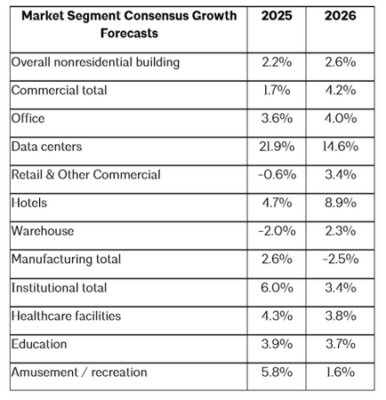

While major construction indicators ended the year as a mixed bag of caution and optimism, the AIA Construction Consensus Forecast Panel forecasted that nonresidential construction spending will slow to 2.2% growth in 2025 and 2.6% in 2026.
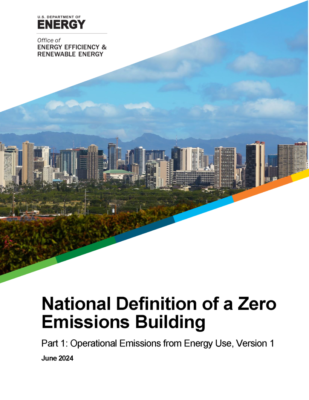
The U.S. Department of Energy (DOE) recently announced a National Definition of a Zero Emissions Building to advance public and private sector efforts to decarbonize the buildings sector, which is responsible for more than one-third of total U.S. greenhouse gas emissions.
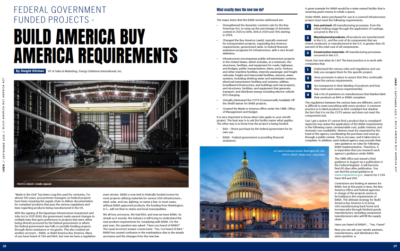
Enacted as part of the Infrastructure Investment and Jobs Act on November 15, 2021, The Build America Buy America Act, or BABA, established a domestic content procurement preference for all infrastructure projects receiving Federal financial assistance after May 14, 2022.
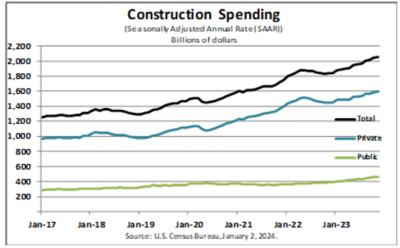
Image credit: U.S. Department of Commerce.
Construction spending is expected to grow in 2024 but at a significantly slower pace, according to the American Institute of Architects (AIA) Construction Consensus Forecast Panel made up of leading economic forecasters. The Panel forecasted that nonresidential construction spending will slow to 4% growth in 2024 and further slow to 1% growth in 2025.

Everywhere, we see signs the LED revolution has won. An argument can be made, however, that this mature lighting technology is simply entering its next phase of market opportunity. Call it LED Revolution 2.0.

The 2016 Paris Agreement called for its nearly 200 signatories to join in limiting global warming to an increase of 1.5 degrees Celsius above pre-industrial levels. This would require carbon emissions to be reduced by about half by 2030 and reach net zero by 2050. To reach this goal, the rate of retrofits in the Global North will need to triple from barely 1 percent to at least 3 percent of stock each year, according to Retrofitting Buildings to be Future-Fit, a November 2022 report by commercial real estate services firm Jones Lang LaSalle (JLL).
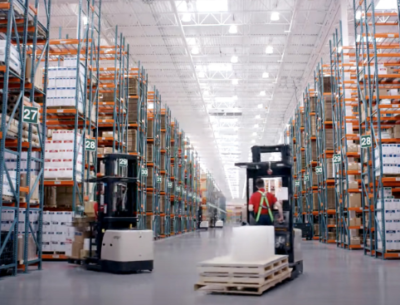
Image courtesy of Synapse Wireless
The United States is currently enjoying a dramatic surge in construction in manufacturing infrastructure. This suggests fresh demand for lighting and controls and the expertise to properly apply them to industrial spaces.
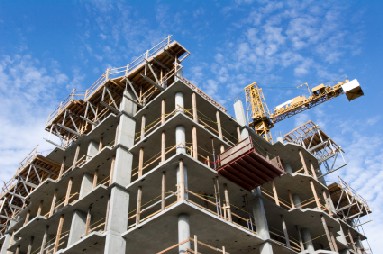
A major contributor to the economy is construction, which overall exhibited very strong growth in 2022. Despite a strong finish to the year, however, nonresidential construction spending is expected to moderate in 2023 and slow significantly in 2024, according to the American Institute of Architects (AIA) Construction Consensus Forecast Panel made up of leading economic forecasters. The Panel forecasted that nonresidential construction spending will moderate to grow a healthy 5.8% in 2023 but then slow to less than 1% in 2024.
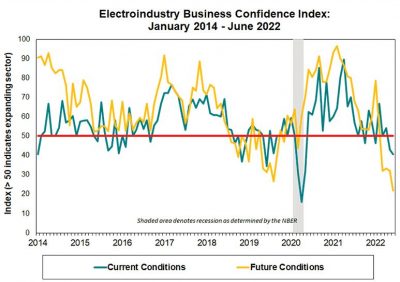
Current electroindustry business conditions edged lower in June 2022, with the National Electrical Manufacturers Association’s (NEMA) Electroindustry Business Confidence Index (EBCI) score staying below the no-change threshold level of 50 for the second consecutive month with a score of 40.6.
According to the AIA Construction Consensus Forecast Panel of leading economic forecasters, nonresidential building construction spending is expected to expand 5.4% in 2022 and strengthen to a 6.1% expansion in 2023.
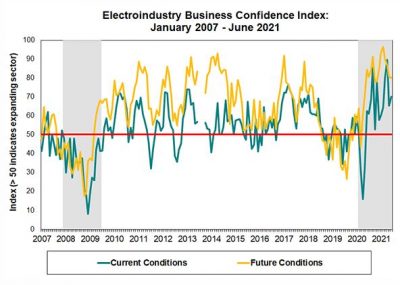
A slight improvement in confidence boosted the National Electrical Manufacturers Association’s (NEMA) Electroindustry Business Confidence Index’s current conditions from a reading of 65.4 last month to 70 points in June.
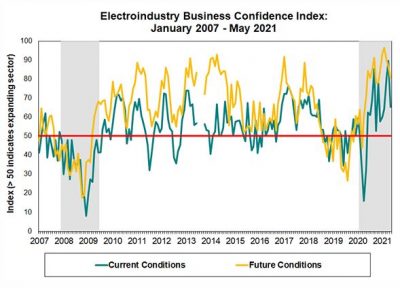
The National Electrical Manufacturers Association (NEMA) recently reported its Electroindustry Business Confidence Index (EBCI) dipped 24 points from a high-water mark in April to 65.4 in May 2021, a significant decline but still solidly in expansionary territory.
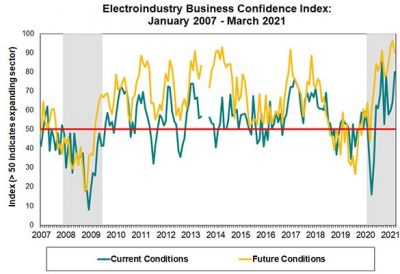
For the tenth consecutive month, the National Electrical Manufacturers Association (NEMA) Electroindustry Business Conditions Index (EBCI) topped 50 points, indicating conditions conducive to growth. March’s reading of 80 built on an already robust 64.3 in February and was driven by two-thirds of survey respondents’ indicating better conditions.
In January 2021, the American Institute of Architects’ (AIA) semi-annual Consensus Construction Forecast, a survey of the nation’s leading construction forecasters, projected a 5.7% decline in nonresidential construction spending in 2021. Construction spending is then projected to grow 3.1% in 2022 as the renewal of economic activity unleashes pent-up demand for nonresidential space.
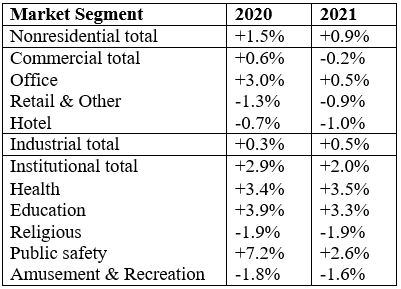
The U.S. economy grew by 2.2% in 2019 and is expected to slow to 2% in 2020, according to the most recent forecast released by the Federal Open Market Committee Meeting on December 11, 2019. The slowdown in 2019-20 is considered a byproduct of the trade war. A major contributor to the economy is construction, and the outlook for construction spending in 2020-21 is positive but lower than 2019. The AIA’s semi-annual Consensus Construction Forecast, a survey of the nation’s leading construction forecasters, is projecting 1.5% growth in nonresidential construction spending in 2020 and 1% in 2021.
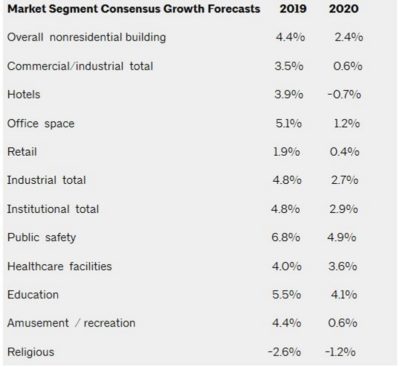
The AIA’s semi-annual Consensus Construction Forecast, a survey of the nation’s leading construction forecasters, is projecting 4.4% growth in nonresidential construction spending in 2019 and 2.4% in 2020. This article by Craig DiLouie, LC, CLCP reviews the forecast and leading construction industry economic indicators.
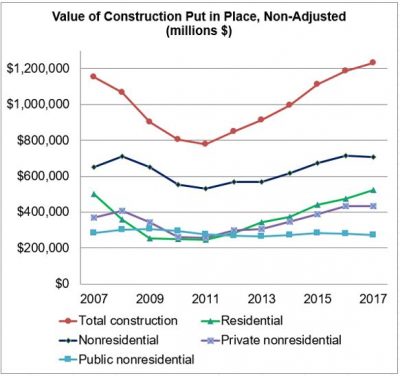
The U.S economy grew by 2.5% in 2017, outpacing 2016, and is expected to produce similar growth in 2018. A major contributor to the economy is construction, and the outlook for construction spending in 2018 overall is positive, particularly nonresidential. The AIA’s semi-annual Consensus Construction Forecast, a survey of the nation’s leading construction forecasters, is projecting 4% growth in nonresidential construction spending in 2018 and 3.9% in 2019.
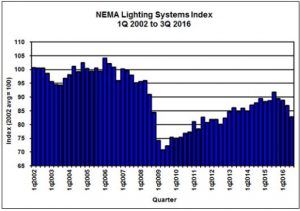
U.S. real GDP slowed to 1.6% in 2016, the lowest growth rate since 2011. However, the outlook for construction spending in 2017 continues to be positive for all market sectors. The AIA’s semi-annual Consensus Construction Forecast, a survey of the nation’s leading construction forecasters, is projecting nearly 6% growth in nonresidential construction spending in 2017, [...]
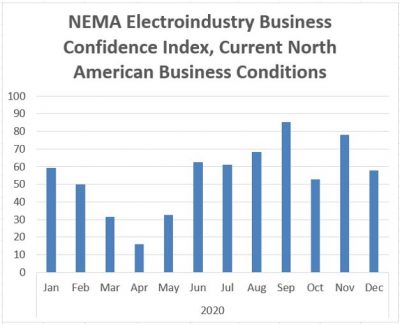
Although some respondents noted weakness in their markets, the National Electrical Manufacturers Association (NEMA) Electroindustry Business Confidence Index (EBCI) indicates a decidedly positive shift overall as the current conditions index moved from 57.9 in November to 66.7 in December.
GDP ended 2015 strongly with an annual estimated growth rate of 2.4%. The overall U.S. economy continues to improve. Positive economic conditions continue to support growth in demand for nonresidential construction. The nonresidential construction sector enjoyed double-digit growth in 2015, and strong momentum is expected to continue in 2016. The AIA’s semi-annual Consensus Construction Forecast, [...]
The U.S. Department of Energy (DOE) has begun releasing results from the 2012 Commercial Buildings Energy Consumption Survey (CBECS). The CBECS is an estimated profile of the U.S. commercial building stock based on an interviewed sampling. Information includes number of buildings, floorspace, age, building type, region, energy consumption, end-use equipment and more. DOE defines a [...]
The overall economy continues to improve, with all major economic indicators signaling a trajectory of continuing growth. GDP ended 2014 very strongly, with forecasts calling for 3% growth in 2015. Business confidence reached a level of 61, signaling average belief in expansionary business conditions. Economic conditions are supporting growth in demand for construction activity, particularly [...]
Despite a national recovery from the recession in 2009, construction activity in the United States continued to spiral downward in following years. Total construction spending declined to under $800 billion in 2011 from its peak of more than $1 trillion in 2008. In 2012, the market turned a corner and achieved a level of growth [...]
Although the national economic recovery is now two and a half years old, construction spending has continued to contract. A multitude of factors prevented a recovery for this beleaguered industry in 2011. Lenders that have been extremely reticent to finance construction projects, budget shortfalls at all levels of government, the ripple effect of overbuilding, depletion [...]
While activity for institutional projects should hover near 2010 levels, there is likely to be a modest decline in commercial construction in 2011, according to the AIA Consensus Construction Forecast Panel. Overall nonresidential construction spending is expected to decrease by 2% for the year. The Panel believes 2012 will produce stronger gains, however, with overall building construction rising about 5%, with growth twice the rate of the more cyclical commercial sector. This construction outlook reviews the year’s top line construction numbers, shows where leading construction and electrical industry indicators are trending, and provides a summary of the latest AIA Consensus Construction Forecast for 2011.
This construction outlook reviews the year’s topline construction numbers, examines the directions that leading construction and electrical industry indicators are pointing, and provides a summary of the latest AIA Consensus Construction Forecast for 2010.

In this video by the Northwest Energy Efficiency Alliance, two lighting experts bust popular myths about luminaire-level lighting controls (LLLCs).
The DesignLights Consortium (DLC) offers a free series of training videos covering various aspects of networked lighting controls.

In this episode of the Lighting Controls Podcast co-produced by the Lighting Controls Academy and sponsored by manufacturer MaxLite, hosts C. Webster Marsh and Ron Kuzmar interview industry veteran Mitch Hefter, LC, MIES of Mitch Hefter Consulting.

MaxLite offers a robust library of training videos at its website covering a wide range of topics, including the company’s basic controls, EasyRF Controls, networked lighting controls, and partner Silvair’s networked controls.

At NYControlled, the EdisonReport’s Randy Reid interviewed Shana Longo, Director, Strategic Initiatives, Intelligent Buildings, Legrand, about the Wattstopper i3 platform. Longo explains how the system uses smart lighting data, cloud-based software, and AI to deliver interoperability, insights, and intelligence for building optimization.

At NYControlled, the EdisonReport’s Randy Reid interviewed Steven Zhou, Executive Vice President at mwConnect, about the company’s new Bluetooth NLC-based thermostat.

At NYControlled, the EdisonReport’s Randy Reid interviewed Martin Mercier, Marketing Manager for IoT Connected Systems at Cooper Lighting, about the company’s new ILC EVO Lightroom controller and Wavelink emergency lighting system.

At NYControlled, the EdisonReport’s Randy Reid interviewed Joe Briscoe, Technical Sales Specialist at Leviton, to discuss the company’s latest lighting control solutions designed to simplify installation and enhance performance.

At NYControlled, the EdisonReport’s Randy Reid interviewed Legrand’s Harold Jepsen, a member of the board of the Lighting Controls Academy, about lighting control trends, the mission of the Lighting Control Academy, and the launch of the new Design Express tool.

At NYControlled, the EdisonReport’s Randy Reid interviewed Chris Primous, EVP of Sales & Marketing at LiteTrace Brands, about the company’s latest products and innovations.
























©2025 Lighting Controls Academy, a coalition of the National Electrical Manufacturers Association. Information published at this website has been obtained from sources believed to be reliable. Damages arising from errors, omissions or damages as from the use or misuse of this information are not the responsibility of NEMA nor its vendors. It is not the intent of this site to provide professional services.
This site rocks with Focus.