Adoption of the most robust connected lighting systems has been slower than expected. Training, education, field validation, greater interoperability, and greater standardization of utility rebate programs are strong opportunities to meet the challenges. These are some of the conclusions of the U.S. Department of Energy’s Connected Lighting Systems Stakeholders Research Study, published in September 2021.
Commercial buildings in the United States are getting larger and more commonly include energy-saving features like LED lighting and occupancy sensors, according to the U.S. Department of Energy’s 2018 Commercial Buildings Energy Consumption Survey (CBECS), published in September 2021.
In A National Roadmap for Grid-Interactive Efficient Buildings, DOE outlines its national goal to triple the energy efficiency and demand flexibility of buildings by 2030. A subsequent report, published in December 2019, specifically evaluates the potential for lighting and electronics (primarily consumer plus IT equipment) to optimize energy efficiency and comfort while providing services back to the grid. This article examines lighting’s potential to support grid interactivity, primarily in the form of networked lighting controls and automated demand response.
The Illuminating Engineering Society (IES) recently published ANSI/IES LP-12-21, IoT Connected Lighting. This 43-page Lighting Practice and American National Standard provides guidance for lighting professionals to consider and evaluate connected lighting and Internet of Things (IoT) solutions and applications.

ux Graphic designer creative sketch planning application process development prototype wireframe for web mobile phone . User experience concept. (ux Graphic designer creative sketch planning application process development prototype wireframe for we
Outcome-based commercial-building energy codes are an idea gaining new interest among policymakers in the United States. This type of energy code prescribes building energy budgets instead of a complex list of requirements. The first efforts started 10 years ago, and we are still years away from a model sure to gain significant adoption. Due to the concept’s potential benefits, however, it is possible, if not likely, that outcome-based codes will be a tool in future energy regulation.

Top three value proposition choices for DC lighting and building microgrids among industry stakeholders interviewed by PNNL.
Direct current (DC) is emerging as a competitive or complementary power distribution option at the grid, community, and building level. Among the advantages for building owners is potential efficiencies in operating DC-based LED lighting and controls as well as plug-and-play sensor and controls installation, including networking that can unlock Internet of Things (IoT) applications.
MaxLite recently introduced the next generation of FlatMax LED Flat Panels with field-selectable CCTs, wattages and field-installable controls as a flexible and future ready lighting solution for offices, schools, health care facilities, and other commercial spaces.
Historically, an inhibitor to adoption of LLLC has been initial cost. An encouraging new study by the Northwest Energy Efficiency Alliance (NEEA) reveals that average costs have been undergoing a steep decline, making advanced controls more attractive for lighting upgrades and new construction.
Rebates remain a strong incentive for investing in energy-efficient lighting and controls. In 2021, significant opportunities are widely available for LED lighting and controls, including continuing availability of rebates for networked controls.
In January 2021, the International Code Council published the 2021 version of the International Energy Conservation Code (IECC), which has been updated every three years since 2000. This new version reduces lighting power allowances, expands mandatory controls requirements, and issues clarifications.
In January 2021, the American Institute of Architects’ (AIA) semi-annual Consensus Construction Forecast, a survey of the nation’s leading construction forecasters, projected a 5.7% decline in nonresidential construction spending in 2021. Construction spending is then projected to grow 3.1% in 2022 as the renewal of economic activity unleashes pent-up demand for nonresidential space.
While “circadian lighting” varies in definition, it generally refers to design that uses intensity and spectrum of light for a non-visual effect—namely, to support regulation of circadian rhythms. A new study suggests that by enabling intensity and spectral adjustment and optimizing exposure based on time of day, designers and owners can minimize the energy tradeoff imposed by associated typically much-higher light levels. This would entail use of an advanced lighting control system capable of scheduled dimming and perhaps spectral emission adjustment.
A U.S. Department of Energy-funded Pacific Northwest Energy Laboratory (PNNL) study found that hospital nurses value controllability in lighting and that this controllability can translate to greater satisfaction among patients.
The Northwest Energy Efficiency Alliance (NEEA) recently published a study seeking to compare one-for-one luminaire level lighting control (LLLC) retrofits with a comprehensive networked lighting controls (NLC) redesign. Conducted by the University of Oregon, the study found that a one-for-one LLLC upgrade produced comparable energy savings and lighting quality at a competitive cost.
With increasing frequency, lighting control systems are tasked to interoperate with other building systems such as building automation systems (BAS) to share information and automate building functionality. Ensuring communication and smooth interoperability is called integration, a potentially challenging undertaking during a project. This is the topic of a new Education Express course developed for the Lighting Controls Association by C. Webster Marsh, HLB Lighting Design.
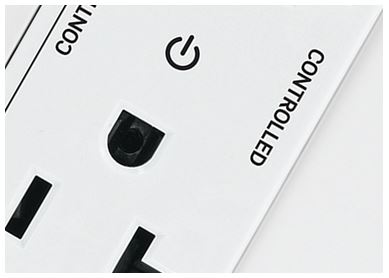
This article, based on the Lighting Controls Association’s new Education Express course EE202: Automatic Plug Load Control, provides an overview of approaches used to automatically control plug loads in commercial buildings.
The U.S. Department of Energy’s (DOE) Interior Lighting Campaign is undergoing a fresh launch as the Integrated Lighting Campaign in June 2020. The program’s core goal of market transformation is the same, with many of the same services and benefits to participants, but the promoted suite of technologies is now going beyond LED adoption toward integrated systems. The Lighting Controls Association is proud to support this program as a member of its Organizing Committee and an inaugural Supporter.
The Lighting Controls Association is proud to announce the latest offerings in lighting controls from industry-leading manufacturers. Check them out!
Current stay-at-home regimes resulting from the COVID-19 pandemic has had a significant impact on how the construction industry works, including education, with online distance-education becoming more popular. The Lighting Controls Association is proud to offer Education Express, a free, robust series of courses covering all aspects of lighting control, including technology, application, design, and commissioning.
Reducing initial cost by an estimated 20-25 percent, rebates remain a strong incentive for investing in energy-efficient lighting and controls. In 2020, significant rebate opportunities are widely available for LED lighting and controls, including growing availability of rebates for networked controls.
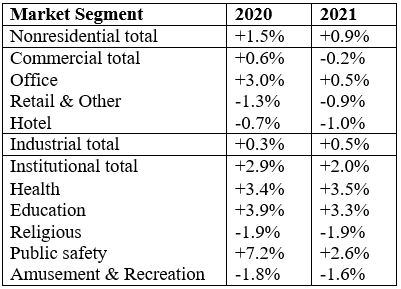
The U.S. economy grew by 2.2% in 2019 and is expected to slow to 2% in 2020, according to the most recent forecast released by the Federal Open Market Committee Meeting on December 11, 2019. The slowdown in 2019-20 is considered a byproduct of the trade war. A major contributor to the economy is construction, and the outlook for construction spending in 2020-21 is positive but lower than 2019. The AIA’s semi-annual Consensus Construction Forecast, a survey of the nation’s leading construction forecasters, is projecting 1.5% growth in nonresidential construction spending in 2020 and 1% in 2021.
Next month, the 2016 version of ANSI/ASHRAE/IES 90.1, Energy Standard for Buildings except Low-Rise Residential Buildings, takes effect as the national energy reference standard, based on a 2018 Department of Energy (DOE) ruling. By February 2020, all states must adopt a commercial building energy code at least as stringent as the standard, or justify why they cannot comply.
The American Society of Heating, Refrigerating, and Air-Conditioning Engineers (ASHRAE) and the Illuminating Engineering Society (IES) recently published ANSI/ASHRAE/IES Standard 90.1-2019, Energy Efficiency Standard for Buildings Except Low-Rise Residential Buildings. This edition includes more than 100 changes from the 2016 version, covering administrative and enforcement, commissioning, mechanical, and lighting. For lighting, the new version adjusts interior power allowances, updates several control requirements, and introduces a simplified compliance method for office, school, and retail buildings.
The American Society of Heating, Refrigerating, and Air-Conditioning Engineers (ASHRAE) recently published guides on how to design buildings that achieve net-zero energy consumption without compromising quality.
Building upon previous guides targeting deep energy savings, the first two new guides were developed in partnership with the American Institute of Architects, Illuminating Engineering Society, and U.S. Green Building Council, and target K-12 and small to medium office buildings.
By early 2020, the American Society of Heating, Refrigerating, and Air-Conditioning Engineers (ASHRAE) is expected to release a new version of the BACnet building automation system protocol. BACnet Secure Connect, or BACnet/SC, brings this popular open industry standard into the Internet of Things (IoT) age by enabling the easy and secure transfer of large volumes of data.
In August 2019, the University of Oregon published a whitepaper, “The Impact of Lighting and Views in the Workplace of the Future.” The paper concludes that daylighted spaces with controlled lighting and views can improve occupant well-being, workplace productivity, and satisfaction by positively influencing various physiological and psychological processes. Lighting and views also impact property value and employee recruitment and retention, the researchers said.
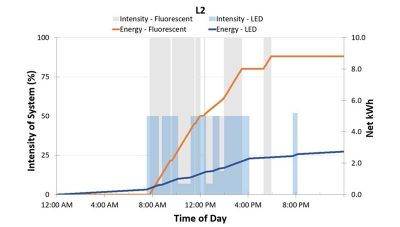
Comparison of intensity and energy consumption of the fluorescent and tunable-white LED systems on a typical day in Classroom L2.
Tunable-white LED lighting offers highly efficient general illumination combined with dimming and the ability to tune correlated color temperature (CCT) from warm- to cool-white. A strong potential application is classrooms, where teachers can set lighting/visual conditions to support classroom activities. In May 2019, the Department of Energy (DOE) published a Pacific Northwest National Laboratory (PNNL) report evaluating a trial installation of tunable-white lighting systems at three classrooms in an elementary school in Folsom, California.
The Lighting Research Center (LRC) recently published a new DELTA report evaluating new sensor-controlled LED corridor lighting installed in a multifamily residential building in Albany, New York. The project showed significant energy savings while overall occupant response was positive.
This article provides general introductory knowledge about the lighting control requirements imposed by the 2016 version of ASHRAE/IES 90.1 and the 2018 version of the IECC.

Hipster business successful teamwork concept, business group assembling jigsaw puzzle
Lighting as a Service (LaaS) is an emerging and evolving business model in which the owner pays for light rather than the equipment that delivers it. The owner buys new lighting on a subscription basis over a multi-year term rather than a significant one-time capital investment.
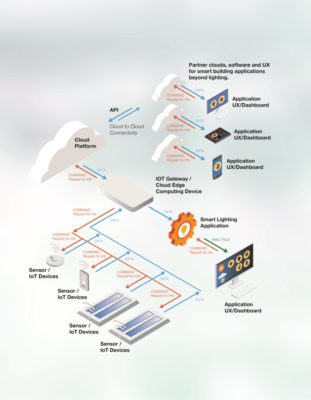
The Internet of Things at a glance, highlighting the lighting and networked control system. Data from sensors flows to a server or the Cloud, where it is analyzed and used for lighting management. Data can also be shared with other building systems and third-party software. The shown lighting and control system is readily achievable today. What happens beyond to create a single smart building that harvests and translates data into meaningful action is quickly developing. Image courtesy of OSRAM.
Networked lighting controls can reduce energy consumption by an average 47 percent, according to a recent industry study. That makes control a powerful tool in managing energy costs, but it only captures a small fraction of its potential value in enhancing quality lighting with LED technology.
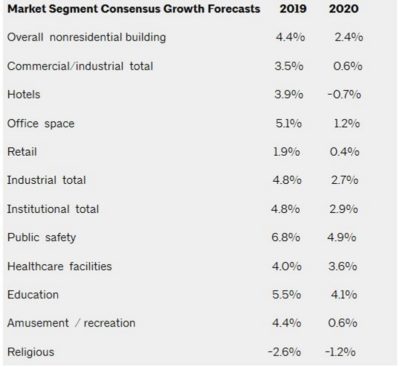
The AIA’s semi-annual Consensus Construction Forecast, a survey of the nation’s leading construction forecasters, is projecting 4.4% growth in nonresidential construction spending in 2019 and 2.4% in 2020. This article by Craig DiLouie, LC, CLCP reviews the forecast and leading construction industry economic indicators.
Cybersecurity is a challenge for the Internet of Things (IoT) as a whole (and corporate information networks beyond that), and lighting is not immune. This article discusses the issues involved and what specifiers and designers can do to mitigate any risks.
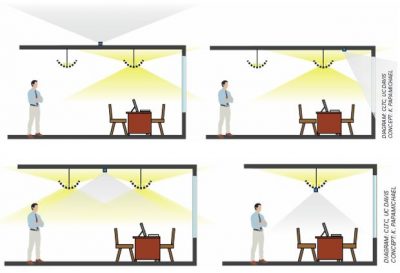
Photosensor placement and field of view for open-loop sensors (top) and closed-loop sensors (bottom). Image courtesy of CLTC.
In August 2018, the California Lighting Technology Center (CLTC) published a best practices guide for designing daylight harvesting lighting control systems. Titled Daylight Harvesting for Commercial Buildings Guide, it focuses on compliance with California’s Title 24 energy code, though it has broad application.
In August 2018, the DesignLights Consortium (DLC) released Energy Savings Potential of DLC Commercial Lighting and Networked Lighting Controls, which projects energy savings for LED commercial lighting and networked lighting controls. The report makes a case that to continue getting big energy savings from lighting for another decade, utility rebate program administrators should transition to supporting LED luminaires and networked controls.

The Internet of Things at a glance, focusing on the lighting and control system. Data from sensors in a networked lighting system flows to a server or the Cloud, where it is analyzed at a workstation that in turn is used for lighting management. Data can also be shared with other building systems and third-party software. The shown lighting and control system is readily achievable today. What happens beyond to create a single smart building that harvests and translates data into meaningful action is developing. Image courtesy of Cree.
Networked control and connected luminaire manufacturers are now promoting their products as “IoT enabled.” This means when the IoT does arrive, the lighting system will stand ready to play a part in it without significant additional cost. The converse may also be regarded as true, which is without connected lighting, any new LED lighting may instantly become obsolete after installation.

Image courtesy of Lutron Electronics.
Software plays a central role in commissioning, operating, and analyzing data collected by networked lighting control systems. As connected lighting becomes more popular, manufacturers continue to make their software simpler, more robust, more portable, and require less training. Software is a major touch point regarding the lighting control system serving either as a platform or an integral part of implementing the Internet of Things in commercial buildings.
On July 26, 2018 the International Code Council published the 2018 version of the International Energy Conservation Code (IECC), which has been updated every three years since 2000. This 2018 version reduces lighting power allowances, broadens mandatory controls requirements, and issues clarifications.
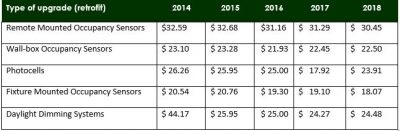
Table 2. Popular lighting control rebates. Source: BriteSwitch North American Rebate and Incentive Database, February 2018.
The most popular lighting control rebates continue to be occupancy sensors, light sensors, and daylight dimming systems. The average rebate for controls is fairly high when one considers their cost, positioning them as an attractive add-on to a retrofit. In some cases, such as high-bay lighting, the rebate can almost completely cover the cost of adding a luminaire-mounted occupancy sensor.
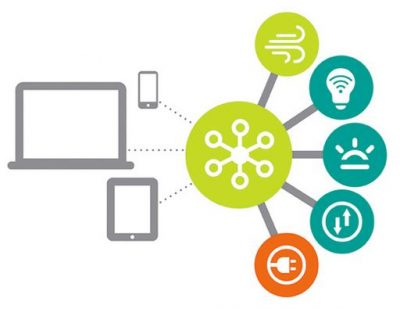
Image courtesy of Audacy Wireless Lighting Control
For input devices and luminaire controllers to interact in many applications, a signal pathway is needed. This may be wiring or, more recently, wireless, with control signals sent through the air. This approach eliminates the need for control wiring, resulting in significant benefits, particularly in existing buildings. Using wireless communication, control devices can communicate as discrete devices or as part of networked systems. Click to read this article by Steve Mesh, LC and Craig DiLouie, LC, CLCP.